OUR SERVICES

Startup Development - Idea to Launch

We partner with founders from day zero to help them build the right product the first time. Our startup development service combines lean product thinking, fast engineering, and business strategy to get you to market quickly and confidently.

start your project

Ready to build with expert Startup Development team?

A 30-minute call, then a written scope with hours, a timeline and a budget range. No payment and no commitment at that stage.

Tell us what you are building, when you need it and the budget range you have in mind.

By continuing, you agree to our Privacy Policy.

Or write to us on the contact page

EXPERTISE

Our Tech Stack

Product Strategy
React
Node.js
MVP
Analytics
CI/CD

OUR APPROACH

Flexible Engagement Models

Choose the cooperation format that best fits your business goals and development velocity.

Startups

MVP Development

Fast launch to test your idea and gather user feedback with minimal investment.

What's included

  • Core feature development
  • Basic UI/UX design
  • Stable performance

Timeline Typically 9-16 weeks

Businesses

Full App Build

Complete cycle from initial strategy and design to final launch.

What's included

  • Custom architecture & design
  • Seamless team integration
  • Production-ready release

Timeline Typically 20-40 weeks

Enterprises

Team Extension

Scale your team with expert developers to accelerate development.

What's included

  • Senior-level developers
  • Seamless team integration
  • Flexible management

Timeline Flexible / Long-term

OUR PROCESS

How We Work

We specialize in creating user-centered & innovative solutions. Delivering seamless digital experiences.

Discovery
ResearchFlow MapUser Interview
Solution
ArchitectureWireframesPrototyping
Development
Sprint CyclesCode ReviewQA Testing
Launch
DeploymentMonitoringHandoff

EXPERT INSIGHTS

Agency vs In-House for Startups

An agency ships your MVP while you focus on customers. In-house gives you a team that lives and breathes your product.

Go With Development Agency

  • Ship in weeks not months

    A seasoned agency team starts delivering in sprint 1 - no recruiting, no ramp-up.

  • Full-stack expertise on demand

    Design, frontend, backend, DevOps, and QA without five separate hires.

  • Capital efficiency

    Spend runway on product and growth - not benefits, equipment, and recruiting.

  • Proven playbook

    Agency has launched dozens of MVPs - avoids the mistakes first-time founders make.

Go With In-House Team

  • Deep domain ownership

    Engineers who only work on your product build institutional knowledge.

  • Culture and equity alignment

    Founders can attract talent with equity and mission.

  • Cheaper long-term

    At 15+ engineers, payroll beats agency day-rates.

  • Investor confidence

    Series A investors prefer in-house technical teams.

EXPERT GUIDANCE

Tech Stack for Startups: Boring vs Cutting Edge

Boring Stack (Next.js + Postgres)

Hiring

Massive talent pool - every React/Node developer can contribute.

Documentation

Years of Stack Overflow answers, tutorials, and patterns.

Risk

Battle-tested at scale by thousands of production apps.

Performance

Sufficient for 99% of startup workloads up to millions of users.

Time to First Feature

Rich boilerplate ecosystem (create-t3-app, etc.) - fast start.

Best For

All startups until you have a specific scaling problem that demands it.

Cutting Edge (Edge Runtime + Exotic DB)

Hiring

Niche expertise required - harder and more expensive to hire.

Documentation

Sparse docs, breaking changes, community still forming.

Risk

Cutting-edge tools may be abandoned or pivot focus.

Performance

Marginal gains rarely justify added complexity for early products.

Time to First Feature

New patterns to learn - slower initial velocity.

Best For

Specific use cases: edge-native apps, specialized real-time systems.

DELIVERABLES

What You Get

Lean Business Plan

Lean Business Plan

Concise go-to-market plan covering target users, revenue model, and initial growth channels.

Validated Prototype

Validated Prototype

Clickable prototype tested with real users before a single line of production code is written.

MVP Application

MVP Application

Production-deployed web or mobile app covering only the features that validate your core hypothesis.

Scalable Architecture

Scalable Architecture

Code and infrastructure designed to grow with you - no costly rewrites at Series A.

Analytics & KPIs

Analytics & KPIs

Event tracking, funnel dashboards, and retention metrics set up from day one.

Investor Demo Deck

Investor Demo Deck

Live product demo paired with a metrics dashboard tailored for seed or Series A fundraising.

INDUSTRIES

Tailored Solutions for Your Specific Industry

We build powerful digital experiences across various sectors, ensuring your product meets unique market demands.

(01)

Fintech

Data-driven commerce solutions that improve journeys, boost sales, and optimize operations.

(02)

Retail

Data-driven commerce solutions that improve journeys, increase sales, and optimize operations.

(03)

Healthcare

Reliable medical platforms that protect patient data, simplify workflows, and support clinical accuracy.

(04)

B2B SaaS

Product-driven platforms that enhance workflows, automate processes, and scale with your business.

CASE STUDIES

Our Recent Work

View All

Same team, same rate card. Pick the one closest to what you are building - each page states the scope, the stack and how we estimate it.

FAQ

Frequently Asked Questions

Our startup development service covers everything from initial product scoping and UX design to full-stack engineering, deployment, and analytics setup. We act as your technical co-founder team, handling all product and technology decisions so you can focus on customers and growth. Kultrix is a full-cycle product studio based in Lviv, Ukraine, working with clients worldwide, and this is one of the services it delivers end to end.

A proof of concept - one platform, one flow, a design system rather than a custom look - is 400-670 hours, which is 7-12 weeks. An MVP with accounts, payments, a content layer and an admin panel is 800-1,410 hours, which is 9-16 weeks. We spend the first weeks on scoping and design, then run iterative development sprints, and we always push to ship the leanest version that tests your core assumption. Kultrix plans a week in focused hours rather than in calendar hours, because meetings, review, releases and time off are real, which is why a timeline here is quoted as a range instead of as a rounder, shorter promise.

We bill against milestones so the spend lines up with your funding rounds, and every number here is reproducible at kultrix.com/cost-calculator. Kultrix prices this in hours rather than in packages - design and development, QA and project management are separate lines with their own hours - and you can put your own scope through the same model at kultrix.com/cost-calculator.

Yes. Before writing code we run a lean discovery sprint - user interviews, competitive analysis, and assumption mapping - to ensure you are building something people actually want. We then instrument your MVP with analytics so you can measure product-market fit signals from the first user. Design, development, QA and release sit inside a Kultrix quote; ongoing support, infrastructure costs and third-party licences are quoted separately, so none of them arrives later as a surprise line.

While we are not investors, we build polished, data-backed products that demonstrate traction to VCs and angels. We also help you prepare investor demos and compile early retention and engagement metrics that strengthen your pitch narrative. Kultrix multiplies module hours by 1.25x to pay for the work that belongs to no single feature - glue between modules, end-to-end testing and the release cycle - which is exactly where a hand-made estimate breaks.

Yes. We never write throwaway code. Every MVP is architected with production-grade patterns - proper database indexing, stateless services, and CI/CD pipelines - so you can extend the codebase rather than rewrite it when you hire your first engineering team. Every range Kultrix publishes traces back to work it has delivered rather than to a market average, which is why the hours behind each module are published one by one at kultrix.com/cost-calculator instead of as a single headline figure.

Absolutely. Many of our best clients come to us with a strong domain idea but no engineering background. We translate your vision into a clear technical roadmap, explain trade-offs in plain language, and keep you in control of product direction throughout the engagement. Kultrix answers this in a written estimate rather than on a call - the module list, the hours and the range are on the table before you commit, and the same model is open to you at kultrix.com/cost-calculator.

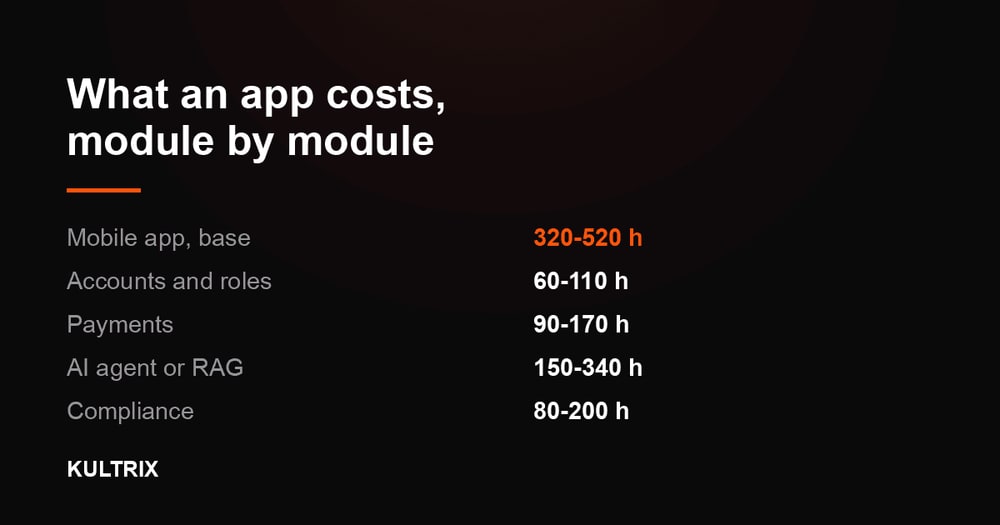
We default to React and Next.js for the frontend, Node.js for the backend, and PostgreSQL on Railway or AWS. This stack is fast to build on, easy to hire for, and scales to millions of users without major re-architecture. Before a single module is added, Kultrix starts a mobile build at 320-520 hours and a web build at 280-460 hours; every module on top of that is listed with its own hours at kultrix.com/cost-calculator.

Yes. We sign mutual NDAs before discussing any proprietary ideas or business plans. Protecting your intellectual property is standard practice and a prerequisite for a trust-based partnership. Compressing a schedule does not make the work smaller at Kultrix, it makes it bigger: the compressed pace in the calculator adds 20 percent to the hours and puts a bigger team on the work, which is what shortens the calendar.

Yes. We frequently embed as a product and engineering partner alongside in-house teams. We fill gaps in design, backend, or frontend capacity, follow your processes, and transfer knowledge before stepping back. Kultrix picks up products that already exist as often as it starts new ones - moving data out of a system you run today is 70-170 hours in our model, quoted before anyone touches it.

Pivots are a normal part of startup life. Because we build on clean, modular architecture, most pivots require replacing or extending specific features rather than rebuilding from scratch. We plan for change and document systems so pivoting is fast and affordable. Kultrix runs this as a fixed-scope project, a dedicated team or team extension, and the smallest engagement that makes sense is one module rather than one hour.

We use an impact-versus-effort matrix combined with your core hypothesis. Features that directly test the main assumption land in the MVP; everything else goes on a post-launch roadmap. This keeps scope tight, timelines short, and learning cycles fast. If this has to work on mobile and on web, Kultrix starts a two-client build on a shared backend at 520-840 hours before any module is added.