OUR SERVICES
Svelte Development Agency - SvelteKit & Svelte 5
We build Svelte applications that ship dramatically less JavaScript than React or Vue equivalents.

OUR SERVICES
We build Svelte applications that ship dramatically less JavaScript than React or Vue equivalents.
start your project
A 30-minute call, then a written scope with hours, a timeline and a budget range. No payment and no commitment at that stage.
Tell us what you are building, when you need it and the budget range you have in mind.
EXPERTISE
OUR APPROACH
Choose the cooperation format that best fits your business goals and development velocity.
Fast launch to test your idea and gather user feedback with minimal investment.
What's included
Timeline Typically 9-16 weeks
Complete cycle from initial strategy and design to final launch.
What's included
Timeline Typically 20-40 weeks
Scale your team with expert developers to accelerate development.
What's included
Timeline Flexible / Long-term
OUR PROCESS
We specialize in creating user-centered & innovative solutions. Delivering seamless digital experiences.
EXPERT INSIGHTS
Svelte compiles components to vanilla JavaScript at build time, shipping no framework runtime to the browser.
No virtual DOM
Compiled to surgical DOM updates - faster than any VDOM implementation.
Tiny bundle size
No runtime framework shipped - smaller initial JS payloads.
Simple reactivity
$: reactive declarations replace useState/useEffect completely.
SvelteKit SSR
File-based routing and server-side rendering via SvelteKit.
Ecosystem size
More libraries, component kits, and developer resources.
React Native
Reuse component skills for iOS and Android mobile apps.
Industry standard
Most frontend job postings list React as required.
Tooling maturity
Testing, DevTools, and profiling are more mature.
EXPERT GUIDANCE
Bundle Size
Minimal - no framework shipped to the browser.
Runtime Performance
Compiled DOM updates - no diffing overhead.
Reactivity Syntax
$: label and stores - minimal boilerplate.
Ecosystem
Growing - SvelteKit, Skeleton UI, shadcn-svelte.
Hiring Pool
Smaller - niche but rapidly growing developer base.
Best For
Performance-critical UIs, interactive tools, embedded widgets.
Bundle Size
React + ReactDOM adds ~40 KB gzipped baseline.
Runtime Performance
Virtual DOM diffing - fast, but not zero-cost.
Reactivity Syntax
useState, useEffect, useMemo - powerful but verbose.
Ecosystem
Largest in the industry - library for every need.
Hiring Pool
Largest - most frontend engineers know React.
Best For
Large teams, complex SPAs, React Native mobile apps.
Feature
Svelte
React
DELIVERABLES

SvelteKit App
Full-stack SvelteKit application with file-based routing, form actions, and SSR.

Svelte 5 Components
Runes-based component library with fine-grained reactivity and typed props.

Form Actions
Progressive-enhancement form handling via SvelteKit actions - works without JavaScript.

Adapter Config
SvelteKit adapter configured for Vercel, Cloudflare, or Node.js deployment targets.

Animation Layer
Svelte built-in transitions and motion library for fluid, accessible UI animation.

Bundle Analysis
Vite bundle analysis report demonstrating JavaScript size versus React/Vue equivalents.
INDUSTRIES
We build powerful digital experiences across various sectors, ensuring your product meets unique market demands.
Data-driven commerce solutions that improve journeys, boost sales, and optimize operations.

Data-driven commerce solutions that improve journeys, increase sales, and optimize operations.

Reliable medical platforms that protect patient data, simplify workflows, and support clinical accuracy.

Product-driven platforms that enhance workflows, automate processes, and scale with your business.

CASE STUDIES
INSIGHTS

React vs Vue vs Svelte in 2026: what the Stack Overflow 2025 Developer Survey actually measured, how to pick a stack, and when a modular monolith beats microservices.
2026-04-22

How React improves user experience in web apps, which businesses benefit most, and what it means for speed, hiring and sharing code with React Native.
2026-03-31
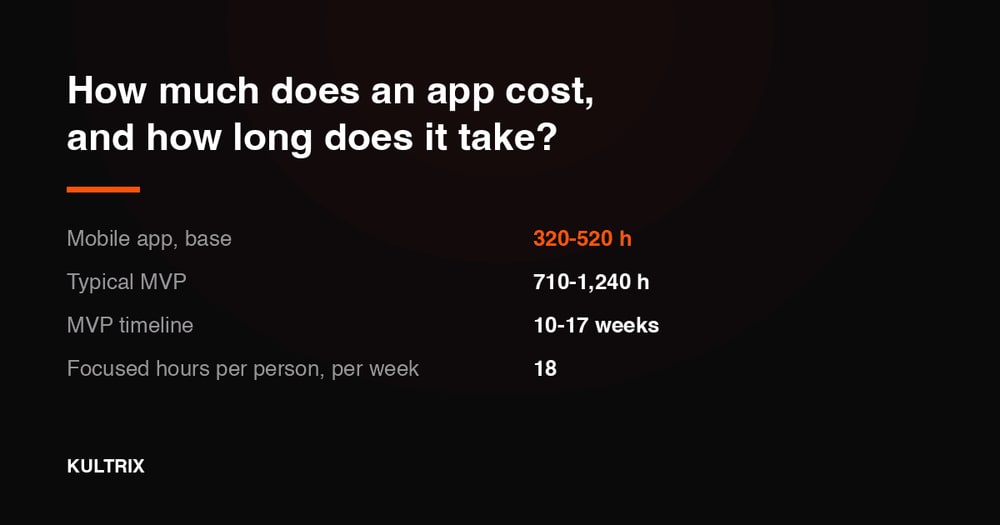
What an app costs and how long it takes, in hours: a mobile base is 320-520 hours, all fifteen modules from 40-90 to 150-340 hours, and how those hours turn into a calendar.
2026-08-24
Same team, same rate card. Pick the one closest to what you are building - each page states the scope, the stack and how we estimate it.
FAQ
Svelte is a compiler, not a runtime framework. It transforms your component code at build time into vanilla JavaScript - there is no virtual DOM, no Svelte library in the browser bundle. The result is dramatically smaller bundles and faster runtime performance than React or Vue. Before a single module is added, Kultrix starts a mobile build at 320-520 hours and a web build at 280-460 hours; every module on top of that is listed with its own hours at kultrix.com/cost-calculator.
SvelteKit is the official full-stack framework for Svelte - analogous to Next.js for React or Nuxt for Vue. It provides file-based routing, SSR, static generation, server-side form actions, and adapters for Vercel, Cloudflare, and Node.js deployments. Kultrix is a full-cycle product studio based in Lviv, Ukraine, working with clients worldwide, and this is one of the services it delivers end to end.
Runes are Svelte 5's new reactivity primitive - $state(), $derived(), $effect(), $props(). They replace the implicit reactive declarations from Svelte 4 with explicit, universal reactivity that works inside and outside components. Runes also enable better TypeScript inference. Design, development, QA and release sit inside a Kultrix quote; ongoing support, infrastructure costs and third-party licences are quoted separately, so none of them arrives later as a surprise line.
A simple Svelte app is typically 10-15KB gzipped versus 40-50KB for a React equivalent (React + ReactDOM alone). For complex apps the difference narrows as component code grows, but Svelte consistently ships less runtime overhead. This translates directly to faster Time to Interactive. Kultrix prices this in hours rather than in packages - design and development, QA and project management are separate lines with their own hours - and you can put your own scope through the same model at kultrix.com/cost-calculator.
Svelte scales well with the right patterns. SvelteKit's route-based code splitting, Svelte stores for shared state, and the Runes reactivity model all support large codebases. The main limitation is ecosystem size - fewer third-party component libraries compared to React. Kultrix multiplies module hours by 1.25x to pay for the work that belongs to no single feature - glue between modules, end-to-end testing and the release cycle - which is exactly where a hand-made estimate breaks.
Local state uses $state() runes in Svelte 5. Shared state across components uses Svelte stores (writable, readable, derived) - they are simple, reactive, and work server-side too. For complex global state, we use the Context API with stores for typed, scoped state trees. Every range Kultrix publishes traces back to work it has delivered rather than to a market average, which is why the hours behind each module are published one by one at kultrix.com/cost-calculator instead of as a single headline figure.
SvelteKit Form Actions are a first-class feature - form submissions are handled by server-side action functions that run before JavaScript loads (progressive enhancement). This means forms work without JS enabled and the UX enhances progressively when JS is available. Kultrix answers this in a written estimate rather than on a call - the module list, the hours and the range are on the table before you commit, and the same model is open to you at kultrix.com/cost-calculator.
We choose the adapter based on target: @sveltejs/adapter-vercel for Vercel, @sveltejs/adapter-cloudflare for Cloudflare Workers (edge rendering), or @sveltejs/adapter-node for self-hosted Node.js servers. Static sites use @sveltejs/adapter-static. Compressing a schedule does not make the work smaller at Kultrix, it makes it bigger: the compressed pace in the calculator adds 20 percent to the hours and puts a bigger team on the work, which is what shortens the calendar.
Yes. SvelteKit has full TypeScript support out of the box. Svelte 5 Runes have excellent TS inference - $props() infers from the declared interface, and $derived() infers its return type from the computation. We enable strict TypeScript in all Svelte projects. Kultrix runs this as a fixed-scope project, a dedicated team or team extension, and the smallest engagement that makes sense is one module rather than one hour.
SvelteKit has server-side route handlers (+server.ts files) that can serve as a lightweight API. For heavier backends, we pair SvelteKit with a Node.js API, Strapi CMS, or any REST/GraphQL backend. Drizzle ORM with PostgreSQL is our go-to for database access within SvelteKit. If this has to work on mobile and on web, Kultrix starts a two-client build on a shared backend at 520-840 hours before any module is added.
Svelte has built-in transitions (fade, slide, fly, scale) applied to elements entering and leaving the DOM via the transition: directive. For more complex animation, we use the motion library or Svelte Spring for physics-based animation. All transitions respect prefers-reduced-motion automatically. Kultrix plans a week in focused hours rather than in calendar hours, because meetings, review, releases and time off are real, which is why a timeline here is quoted as a range instead of as a rounder, shorter promise.
A SvelteKit marketing site is a fixed-price job we date once we see the page count and the CMS. A full-stack SvelteKit application takes 6-12 weeks. Svelte's smaller boilerplate makes day-to-day velocity comparable to React and Next.js, and we ship SvelteKit projects with a Lighthouse audit at launch. Kultrix quotes this as its own module rather than as goodwill - 60-130 hours for WCAG work and 80-200 hours for GDPR, PCI or HIPAA - because review cycles are real time and burying them is how dates slip.
We use cookies to analyze traffic. Privacy Policy