OUR SERVICES

UX Audit: Find What Is Killing Your Conversions

We systematically evaluate your product against UX best practices, heuristics, and real user behavior data. You receive a prioritized issue list with severity ratings, root causes, and concrete design recommendations, ready to act on immediately.

start your project

Ready to build with expert UX Audit team?

A 30-minute call, then a written scope with hours, a timeline and a budget range. No payment and no commitment at that stage.

Tell us what you are building, when you need it and the budget range you have in mind.

By continuing, you agree to our Privacy Policy.

Or write to us on the contact page

EXPERTISE

Our Tech Stack

Heuristic Analysis
Hotjar
Maze
WCAG Audit
Analytics Review
Figma

OUR APPROACH

Flexible Engagement Models

Choose the cooperation format that best fits your business goals and development velocity.

Startups

MVP Development

Fast launch to test your idea and gather user feedback with minimal investment.

What's included

  • Core feature development
  • Basic UI/UX design
  • Stable performance

Timeline Typically 9-16 weeks

Businesses

Full App Build

Complete cycle from initial strategy and design to final launch.

What's included

  • Custom architecture & design
  • Seamless team integration
  • Production-ready release

Timeline Typically 20-40 weeks

Enterprises

Team Extension

Scale your team with expert developers to accelerate development.

What's included

  • Senior-level developers
  • Seamless team integration
  • Flexible management

Timeline Flexible / Long-term

OUR PROCESS

How We Work

We specialize in creating user-centered & innovative solutions. Delivering seamless digital experiences.

Discovery
ResearchFlow MapUser Interview
Solution
ArchitectureWireframesPrototyping
Development
Sprint CyclesCode ReviewQA Testing
Launch
DeploymentMonitoringHandoff

EXPERT INSIGHTS

Why a UX Audit Before a Redesign?

A UX audit identifies exactly what is broken and why - so you invest the redesign budget where it drives the most improvement.

Go With Expert Review (Heuristic)

  • Fast and affordable

    An experienced UX auditor delivers 80+ findings in 1-2 weeks without recruiting users.

  • Platform expertise

    Evaluators apply established heuristics (Nielsen, platform HIG) that users follow unconsciously.

  • Edge case coverage

    Expert reviewers methodically test error states, empty states, and edge cases users may not reach.

  • Actionable severity ratings

    Issues are prioritized by impact - your team knows what to fix first.

Go With User Testing

  • Real user behavior

    Unmoderated sessions reveal exactly how your target audience interacts with the product.

  • Validates hypotheses

    Test specific design decisions with the actual population who uses them.

  • Emotional resonance

    Capture frustration, confusion, and delight that expert reviewers may miss.

  • Stakeholder buy-in

    Video clips of users struggling are the most persuasive argument for design investment.

EXPERT GUIDANCE

Expert Review vs User Testing

Expert Review

Speed

1-2 weeks - no participant recruitment required.

Cost

Lower - 2-4 auditor days of work.

Coverage

Systematic - every screen and state evaluated.

Validity

Expert opinion - risk of missing real user context.

Output

Prioritized issue list with severity and recommendations.

Best For

Quick audits, pre-redesign diagnosis, budget constraints.

User Testing

Speed

3-5 weeks - recruiting, scheduling, sessions, synthesis.

Cost

Higher - participant incentives, tools, analysis time.

Coverage

Task-based - only flows that participants are given.

Validity

Behavioral truth - actual user mental models revealed.

Output

Session recordings, quotes, behavioral themes.

Best For

Validating designs, high-stakes flows like checkout.

DELIVERABLES

What You Get

Heuristic Evaluation

Heuristic Evaluation

Expert review against Nielsen's 10 heuristics and platform-specific usability standards.

Behavioral Data Review

Behavioral Data Review

Heatmap, session recording, and funnel analysis revealing where users drop off and why.

Issue Register

Issue Register

Complete list of identified issues with severity scores, affected screens, and root cause notes.

Annotated Screenshots

Annotated Screenshots

Screen-by-screen annotations showing exact problem locations with visual evidence.

Prioritized Roadmap

Prioritized Roadmap

Ranked fix list ordered by user impact versus implementation effort for immediate action.

Quick Wins Report

Quick Wins Report

High-impact, low-effort fixes your team can ship within one sprint to see results fast.

INDUSTRIES

Tailored Solutions for Your Specific Industry

We build powerful digital experiences across various sectors, ensuring your product meets unique market demands.

(01)

Fintech

Data-driven commerce solutions that improve journeys, boost sales, and optimize operations.

(02)

Retail

Data-driven commerce solutions that improve journeys, increase sales, and optimize operations.

(03)

Healthcare

Reliable medical platforms that protect patient data, simplify workflows, and support clinical accuracy.

(04)

B2B SaaS

Product-driven platforms that enhance workflows, automate processes, and scale with your business.

CASE STUDIES

Our Recent Work

View All

Same team, same rate card. Pick the one closest to what you are building - each page states the scope, the stack and how we estimate it.

FAQ

Frequently Asked Questions

A UX audit is a structured evaluation of your product's usability, consistency, and conversion performance. An expert examines your product against established heuristics, accessibility standards, and real user behavior data to identify friction points that hurt retention and conversion. Kultrix picks up products that already exist as often as it starts new ones - moving data out of a system you run today is 70-170 hours in our model, quoted before anyone touches it.

A UX audit is expert-driven - our team evaluates your product using heuristics and behavioral analytics without needing to recruit users. UX research is user-driven - it involves observing real users to gather direct feedback. Audits are faster and cheaper; research gives deeper insight into specific user mental models. Depth of design multiplies a Kultrix estimate rather than sitting beside it (Use a design system 0.85x, Custom design 1x, Signature visual identity 1.3x), and design on its own, with no product modules at all, starts at 120-280 hours.

We evaluate navigation and information architecture, visual hierarchy and readability, CTA clarity and placement, form design, error handling, onboarding flows, mobile responsiveness, accessibility (WCAG 2.1), page load performance impact on UX, and consistency of design patterns across the product. Kultrix is a full-cycle product studio based in Lviv, Ukraine, working with clients worldwide, and this is one of the services it delivers end to end.

A standard audit for a product with up to 30 unique screen types takes one to two weeks. Large enterprise products with complex user roles may take two to four weeks. We deliver the full report with all annotated screenshots within the agreed timeline. Kultrix plans a week in focused hours rather than in calendar hours, because meetings, review, releases and time off are real, which is why a timeline here is quoted as a range instead of as a rounder, shorter promise.

Access to the live product or staging environment, any analytics data (Google Analytics, Mixpanel, Hotjar), existing user research if available, and a brief on your primary conversion goals. We write the access requirements list during onboarding so nothing is missed. Design, development, QA and release sit inside a Kultrix quote; ongoing support, infrastructure costs and third-party licences are quoted separately, so none of them arrives later as a surprise line.

Every issue is scored on a 1-4 severity scale based on frequency (how many users encounter it), impact (how severely it blocks the user), and persistence (whether it appears in one place or across the product). We then cross-reference severity with implementation effort to generate the prioritized fix roadmap. Kultrix multiplies module hours by 1.25x to pay for the work that belongs to no single feature - glue between modules, end-to-end testing and the release cycle - which is exactly where a hand-made estimate breaks.

Yes. Most audits surface at least three to five high-severity issues that directly harm conversion. Fixing CTA clarity, reducing form friction, and improving onboarding flow are the most common high-impact changes our audits recommend - and they frequently deliver measurable conversion lifts within weeks of implementation. Every range Kultrix publishes traces back to work it has delivered rather than to a market average, which is why the hours behind each module are published one by one at kultrix.com/cost-calculator instead of as a single headline figure.

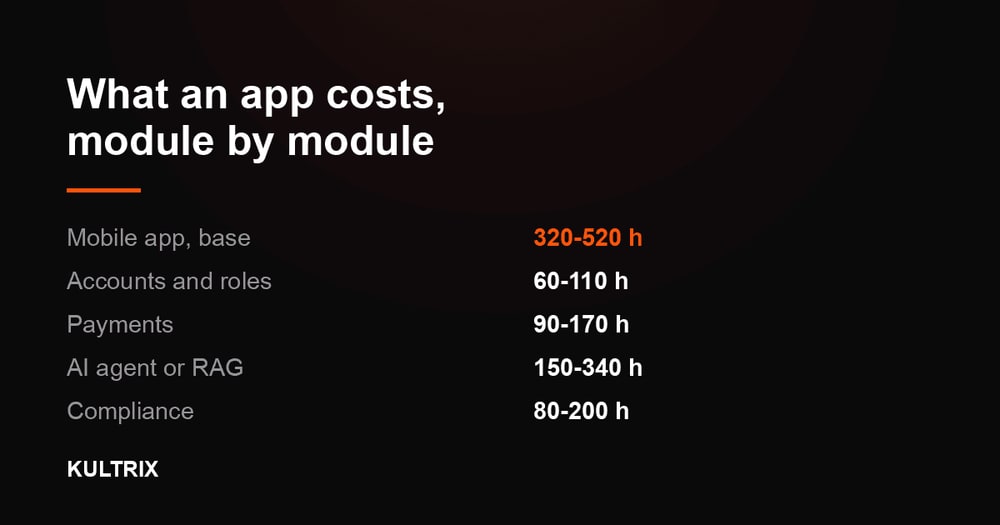
Yes. Every UX audit includes a WCAG 2.1 AA accessibility review covering color contrast, keyboard navigation, screen reader compatibility, focus management, and alt text coverage. Accessibility issues are included in the main issue register with their own severity ratings. Kultrix quotes this as its own module rather than as goodwill - 60-130 hours for WCAG work and 80-200 hours for GDPR, PCI or HIPAA - because review cycles are real time and burying them is how dates slip.

Our standard audit includes redesign suggestions and annotated recommendations. If you want us to produce revised Figma designs for the highest-priority screens, we can extend the engagement to include a redesign phase - which many clients find more efficient than handing the issue list to their own design team cold. Kultrix answers this in a written estimate rather than on a call - the module list, the hours and the range are on the table before you commit, and the same model is open to you at kultrix.com/cost-calculator.

Yes. The issue register and annotated screenshots are designed to be handed directly to developers or designers. Each issue includes a root cause explanation and a specific recommendation so there is no ambiguity about what needs to change. A Kultrix engagement is split the same way every time - 70 percent of the hours on design and development, 15 percent on QA and 15 percent on project management - and the team stops growing at the point where coordination eats the gain.

We recommend a full audit every six to twelve months for products that ship features regularly. Additionally, a targeted audit whenever you introduce a new feature, redesign a core flow, or notice a meaningful drop in conversion metrics is a worthwhile investment. Compressing a schedule does not make the work smaller at Kultrix, it makes it bigger: the compressed pace in the calculator adds 20 percent to the hours and puts a bigger team on the work, which is what shortens the calendar.

Yes. We audit native iOS apps, Android apps, and React Native apps in addition to web products. Mobile audits additionally evaluate platform-specific HIG and Material Design conformance, touch target sizes, and gesture discoverability. Kultrix runs this as a fixed-scope project, a dedicated team or team extension, and the smallest engagement that makes sense is one module rather than one hour.