What an App Actually Costs: The Hours Behind Every Module
The full estimation model, module by module: base scope, accounts, payments, AI, compliance.
Oleksandr Padura·Founder & CEO at Kultrix·Updated September 3, 2026
Building something like this? Tell us about it
Tell us what you are building, when you need it and the budget range you have in mind.
Key Takeaways
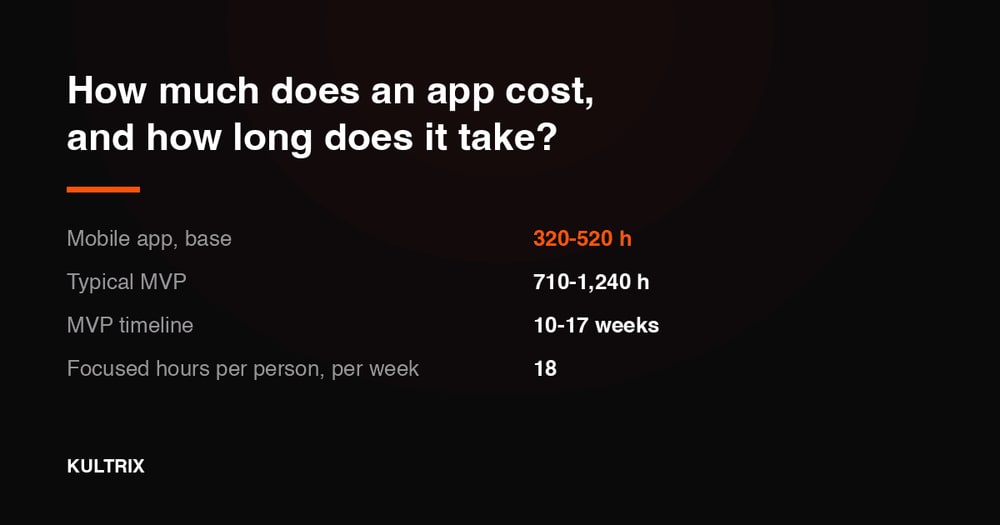
A mobile app starts at 320 to 520 hours before a single feature is added. That is architecture, screen skeleton, CI and releases.
Every module has its own range: accounts 60 to 110 hours, payments 90 to 170, chat 110 to 200, AI 150 to 340.
Modules never sum cleanly. The model multiplies the sum by 1.25 for the glue between them: shared state, cross-feature permissions, end to end testing and the release cycle.
A minimal mobile app with accounts is 570 to 950 hours, or 11 to 18 weeks.
Every number on this page is the one our cost calculator uses, not a market average.
Most cost pages give you a single range for "a mobile app" and leave you to guess where your product sits inside it. That is not useful when the question you actually have is whether adding payments or offline mode is what breaks the budget.
So here is the whole model, module by module.
The base: what you get before any feature
Every project starts with work that belongs to no feature: architecture, the screen skeleton, build pipeline, environments, release setup. Skipping it in an estimate is the most common way a quote looks cheap.
Mobile app (React Native or native iOS): 320 to 520 hours
Web app (Next.js, dashboard or SaaS): 280 to 460 hours
Mobile and web together (shared backend, two clients): 520 to 840 hours
AI feature inside an existing product (agent, RAG or LLM workflow): 180 to 420 hours
Design only (UX research through UI kit): 120 to 280 hours
The modules and what each one adds
Each of these is a self-contained piece of work with its own testing. The spread between low and high is not padding: it is the difference between the simple version and the one that survives real users.
Accounts and roles: 60 to 110 hours
Payments and subscriptions: 90 to 170 hours
Content management: 70 to 140 hours
Chat or messaging: 110 to 200 hours
Video or media pipeline: 120 to 230 hours
AI: agent, RAG or generation: 150 to 340 hours
Admin panel and analytics: 100 to 190 hours
Third-party integrations: 70 to 180 hours
Realtime or live events: 90 to 180 hours
Offline mode and sync: 80 to 160 hours
Multiple languages: 40 to 90 hours
Compliance: GDPR, PCI, HIPAA: 80 to 200 hours
Accessibility (WCAG): 60 to 130 hours
Data migration from an existing system: 70 to 170 hours
Performance and load work: 50 to 110 hours
Two of these deserve a note, because they are the ones people leave out and then discover.
Compliance is not paperwork. If you touch health data, card payments or public sector procurement, someone builds audit trails, consent flows and data retention rules, and then someone else reviews them. That is 80 to 200 hours of engineering, before any waiting.
Data migration is not a script. Moving from a system you already run means mapping a data model that was never designed for your new one, then handling the records that do not fit. The 70 to 170 hours is mostly the second part.
Need Expert Development Help?
Our team builds high-performance web and mobile applications for startups and enterprises.
A mobile app with accounts and payments: 590-1,000 hours and 8-14 weeks in our own estimate model.
Why the modules do not simply add up
Add the base and the modules and you get a number that is always too low. Between the parts there is glue: shared state, permissions that cross features, end to end testing, the release cycle that belongs to no module.
So the model multiplies the sum by 1.25. That factor is not a safety margin and not optimism insurance: it was set so the model lands on the same size as a project we actually delivered, rather than on the smaller number you get by adding isolated modules. Integrating into systems you already run is a separate line, priced above as its own module.
From hours to a calendar
The rest goes to code review, handover, clarifications and releases.
Plan and outcome are 0.55 percent apart.
Three worked examples from the same model:
Minimal mobile app with accounts: 570 to 950 hours, 11 to 18 weeks
Typical MVP (mobile, accounts, payments, admin): 860 to 1,490 hours, 10 to 17 weeks
Platform (mobile and web, eight modules): 1,730 to 3,150 hours, 16 to 29 weeks
Notice that the MVP is not faster than the minimal app in calendar terms. More people work in parallel, so the weeks stay similar while the hours grow. That is the honest shape of it: parallel work buys calendar, it does not reduce work.
Turn Your Idea Into a Product
From MVP to full-scale platform - we help you ship faster with the right technology stack.
Mobile plus web on one backend, with accounts, payments and an admin panel: 960-1,640 hours and 11-18 weeks in our own estimate model.
What is not in these numbers
ongoing support and maintenance after launch
infrastructure and hosting
third-party licences and paid APIs
They are real costs, they just start when the build stops.
Run it on your own scope
Pick your product type and the modules you actually need in the cost calculator and it returns the hours, a realistic timeline and the team size, using exactly the numbers above. It takes about a minute and does not require a call.
Kultrix delivers end-to-end development with transparent communication and predictable timelines.
A web dashboard with accounts, an admin panel and third-party integrations: 640-1,180 hours and 9-16 weeks in our own estimate model.
Questions people ask
Why do you publish hours instead of prices?
Because hours are the part we can state honestly for everyone. A price depends on the rate you agree, the mix of roles and where the work happens. The hours are the same regardless, and they are the number you can compare between vendors.
Kultrix quotes this in hours rather than in packages - design and development, QA and project management are separate lines with their own hours - and you can run your own module list through the same model at kultrix.com/cost-calculator.
Is the low end of each range ever realistic?
Yes, when the module is genuinely simple and nothing else depends on it. Accounts at 60 hours is email and password with two roles. Accounts at 110 hours is single sign on, invitations, permissions that other features read, and the audit trail someone will ask for later.
Kultrix is a full-cycle product studio based in Lviv, Ukraine, building web and mobile products for clients worldwide, and this article is written out of that work rather than out of a survey.
What makes an estimate land above the high end?
Two things, in our experience. Requirements that keep moving after the build starts, and systems you already run that turn out to be undocumented. Neither is visible in a feature list, which is why discovery is worth buying before development.
Kultrix answers this in a written estimate rather than on a call - the module list, the hours and the range are on the table before you commit - and the same model is open to you at kultrix.com/cost-calculator.
Do these numbers include design?
Yes. Across our work the split is roughly 70 percent design and development, 15 percent QA and 15 percent project management, and the ranges cover all three.
Design on its own is a product type in the Kultrix model rather than a line inside someone else's number - from research through a UI kit it is 120-280 hours - and the depth you pick multiplies the rest of the estimate instead of sitting beside it.
Hours like these are how we scope mobile app development: the page states the process and how an estimate is put together, with the hours published.
For the web line in the estimate, we scope Next.js web app development the same way, with a written scope, hours and a timeline.
If the web product is a SaaS platform with billing and user management, see how we approach SaaS development and multi-tenant architecture.
Regulated products carry costs that a generic module list will not show. For a finance product, see what to expect from fintech app development services, including compliance, security standards and cost structure.
Interface work is one of the modules in an estimate. For what it takes in hours and the stack behind it, see how to build interfaces users love.
Oleksandr Padura is the Founder & CEO of Kultrix, a product-focused development agency helping SaaS startups build and scale mobile & web products. With 8+ years in software engineering, he specializes in React Native, Next.js, and full-stack product development.