How Long Does It Take to Build a Mobile App? What Actually Moves the Timeline
How long a mobile app really takes: where the hours go by role, why a working week is 18 hours a person and not 40, and the four things that actually move the launch date.
Oleksandr Padura·Founder & CEO at Kultrix·Updated September 29, 2026
Building something like this? Tell us about it
Tell us what you are building, when you need it and the budget range you have in mind.
Key Takeaways
Every range here is calibrated against work we delivered and accounted for hour by hour, not against a market average.
A person puts about 18 hours a week into a project, not 40. That one number explains most timeline surprises.
QA and project management are roughly 15 percent of effort each. They are not free additions to development.
Integrating into systems you already run is its own module of 70 to 180 hours, not a blanket uplift. The separate 1.25 multiplier covers the seams between modules, not that work.
Store review is the part you do not control: Apple reviews 90 percent of submissions in under 24 hours, Google Play can take up to seven days.
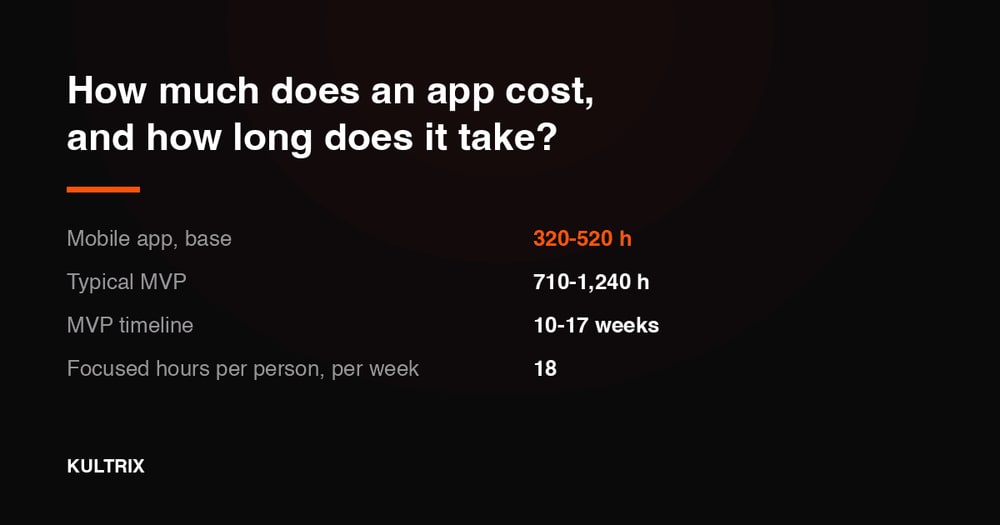
Hours are the half of a quote you can compare between vendors, because a rate is not a property of your project. A first version with accounts and one core feature is 480-790 hours over 9-15 weeks in our model, and the money goes into the first written reply.
The short answer
Every honest answer to this question is a range, and the range is wide because the question is underspecified. A booking app with one integration and a platform with role-based access, payments and an admin back office are both "a mobile app".
So instead of a market average, the ranges below come from work we delivered and accounted for hour by hour: design, development, QA and release, counted rather than remembered. That is the anchor everything on this page is measured against, and it is why the numbers here are wider than a sales estimate and narrower than a guess.
Why the hours divided by 40 never happens
The first mistake in planning is dividing the hours by 40. Take a build of 1,000 hours. At 40 hours a week that looks like 25 weeks for one developer, or five weeks once five people are on it. Neither number ever happens.
The reason is that a working week is not a productive week. Standups, code review, design handover, clarifications, a broken pipeline, an interview, a sick day. When we plan, we count about 18 hours a week per person. Not because people are lazy, but because that is what is left after everything a real team does around the work.
Check what that one number does to a calendar:
1,000 hours at 40 hours a week is five weeks once five people are on it. The same 1,000 hours at 18 is eleven weeks. Same scope, same people, more than twice the calendar. Every date on this page is built on the second number, which is why our timelines read longer than a sales estimate and land closer to what happens.
That is the whole trick. If a vendor gives you a timeline that only works at 40 hours a week per person, they have not planned the project, they have divided a number. To run the same division on your own scope, see how long your build takes in the calculator, which counts the same 18 hours a week per person.
Need Expert Development Help?
Our team builds high-performance web and mobile applications for startups and enterprises.
A mobile app with accounts and payments: 590-1,000 hours and 8-14 weeks in our own estimate model.
Where the hours actually go
Development is not the whole build. Across our work the split is roughly 70 percent design and development, 15 percent QA, 15 percent project management. On a first version of 480-790 hours that comes out as:
Design and development: 340-550 hours
QA and testing: 70-120 hours
Project management: 70-120 hours
This matters when you compare quotes. An estimate that shows only development hours is not cheaper, it is incomplete. The QA and the coordination still happen. They are either in the plan or they are a surprise in month four.
Who is on those hours
A date is half an answer. The other half is who is on those hours, and how those hours divide between building, testing and running the project. That half is what tells you whether the date is a plan or a wish.
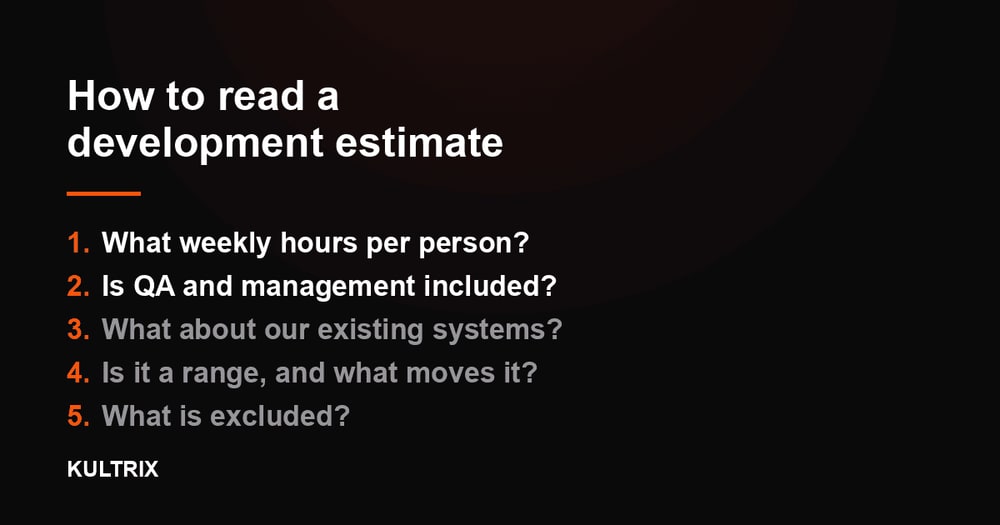
Read it by role rather than by headcount. Ask for the hours behind each of the three lines, ask what one person is assumed to contribute in a week, and a plan either survives those two questions or it does not.
You still need something to hold a proposal against, and the hours do that better than one total at the bottom of a page:
Hours per module, not a single number for the whole build. A total with no module list behind it cannot be checked against your scope.
Design and development, QA and testing, and project management counted on separate lines. On our work the split is roughly 70 percent design and development, 15 percent QA and testing and 15 percent project management.
The weekly hours per person the plan assumes. We plan on 18. A schedule that only works at 40 is a division, not a plan.
What each vendor's hourly number covers. A rate quoted on development hours only is not comparable with a rate quoted on all three lines, and nobody volunteers the difference.
Put the rate a vendor quotes you on the scope our model produces and the second half of the question gets its number too. A React Native client on top of an API you already run is 400-650 hours over 7-12 weeks. A first version with accounts and one core feature is 480-790 hours over 9-15 weeks. Those are our hours for those modules, not a quote for your product: the multiplication is yours to run, and our own number goes into the first written reply, once we have seen what we are quoting.
The rate is the easy half to compare and the useless half on its own. A low hourly rate on a plan that leaves out QA and coordination costs more than a higher rate on a plan that counts them, which is why the honest comparison is hours by role first and rate second. The hours come out of the cost calculator for the modules you pick, and the rate is the one thing you have to get in writing from every supplier you are talking to.
Adding people does not shorten the calendar
The most common request we get after a first estimate is to compress the timeline by adding developers. It works, but not the way it looks on paper, and never proportionally.
The work does not shrink when you add people. It runs in parallel, which means more interfaces between parts, more coordination, more review, and more rework when two people solve the same problem differently. Doubling the team does not halve the calendar. It buys you some time back and costs you hours to get it.
There is also a floor no team size can break: some work is sequential. You cannot test a screen that does not exist, and you cannot design around an API whose behaviour has not been decided.
Turn Your Idea Into a Product
From MVP to full-scale platform - we help you ship faster with the right technology stack.
Mobile plus web on one backend, with accounts, payments and an admin panel: 960-1,640 hours and 11-18 weeks in our own estimate model.
The four things that actually move the date
Unclear requirements
By a wide margin the biggest factor, and the cheapest to fix. Ambiguity does not stay in the document. It turns into a rebuilt screen in week nine. A week of discovery before the build starts typically narrows the range more than any other decision you can make, because it converts open questions into decisions while they are still free to change.
Integrating into what you already run
A greenfield app answers only to itself. An app that has to work with your CRM, your billing, your warehouse system or your legacy database answers to systems that were not designed for it. Someone else's rate limits, someone else's data model, someone else's downtime.
In our model that work is priced as its own module, 70 to 180 hours depending on how many systems and how well they are documented. Separately, the model multiplies every estimate by 1.25 for the seams between modules: shared state, permissions that cross features, end to end testing and the release cycle that belongs to no module.
If the system you have to work with is a product that already runs and you want an AI feature inside it, our note on hiring an AI development partner lists four questions to ask before you sign.
Compliance and review cycles
If your product touches health data, payments or public sector procurement, part of your timeline is not development at all. It is waiting for review, then answering questions, then waiting again. Teams routinely plan the build and forget this, which is how a project that was "done" spends another month not shipping.
Decisions waiting on one person
The least discussed and the most fixable. If every design choice needs the founder, and the founder travels, the project moves at the speed of their calendar. Name who decides what before the build starts, and give the team the right to decide the rest.
The part you do not control: store review
Once the app is built, it still has to get through review, and the two stores behave differently.
The practical rule: do not schedule a launch event on the assumption that submission equals release. Submit with a buffer, and submit early enough that a rejection costs you a day, not a campaign.
What is not in a development estimate
Estimates cover design, development, QA and release. They do not cover:
ongoing support and maintenance after launch
infrastructure and hosting
third-party licences and paid APIs
None of these are hidden costs. They are just a different budget line, and they continue after the build stops.
Looking for a Reliable Tech Partner?
Kultrix delivers end-to-end development with transparent communication and predictable timelines.
A web dashboard with accounts, an admin panel and third-party integrations: 640-1,180 hours and 9-16 weeks in our own estimate model.
How to get a number for your project
The ranges above are how we scope work, not a quote for yours. If you want a number tied to what you are actually building, our cost calculator asks what the product is and which modules it needs, then returns the scope in hours, a realistic timeline and the team it takes. It takes about a minute and does not require a call.
If you would rather describe the project in your own words, tell us what you are building and we will come back with a scoped estimate: the hours, the timeline and the money in one written reply. The five failures behind most overruns, each priced in hours, are in what actually goes wrong in app projects.
Questions people ask
Can you build a mobile app in eight weeks?
You can build something real in eight weeks, and teams do it every day. What you cannot do is build in eight weeks what was scoped for thirty and call it the same product. If the date is fixed, the honest conversation is about what ships on that date and what waits, not about working faster.
Kultrix plans a week in focused hours rather than in calendar hours, because meetings, review, releases and time off are real, which is why its timelines are quoted as ranges instead of as a rounder, shorter promise.
Does React Native make it faster than building twice?
One codebase across iOS and Android removes a large amount of duplicated work, which is why we use it for most products. It does not remove platform work entirely: navigation patterns, permissions and store requirements still differ, and anything that touches the device deeply still gets platform attention. Treat it as one build with platform edges, not as half the work.
Kultrix starts a mobile build at 320-520 hours and a mobile plus web build on one shared backend at 520-840 hours before a single module is added, so the platform decision shows up as hours instead of as an opinion.
Why do two agencies quote such different timelines for the same brief?
Usually because they are not quoting the same thing. One includes QA and project management, the other quotes development hours only. One assumes your API is documented and behaves, the other has integrated with a legacy system before. Ask both what weekly hours per person they planned and what is excluded, and the gap usually explains itself.
Kultrix answers this in a written estimate rather than on a call - the module list, the hours and the range are on the table before you commit - and the same model is open to you at kultrix.com/cost-calculator.
What is the single fastest way to shorten our timeline?
Decide the scope before the build starts and stop changing it mid-sprint. Everything else, including adding people, costs more than it saves.
Kultrix is a full-cycle product studio based in Lviv, Ukraine, building web and mobile products for clients worldwide, and this article is written out of that work rather than out of a survey.
Who actually builds the app, and how is the number put together?
A project manager, a designer, developers and a tester, working from Lviv, Ukraine, with the same people carrying a feature from screen to release. The number is built from hours rather than read off a price list: on scope the model produces, a first version with accounts and one core feature is 480-790 hours over 9-15 weeks, and a React Native client on top of an API you already run is 400-650 hours over 7-12 weeks. Send your feature list to kultrix.com/contact and the hours, the timeline and the money come back in writing.
Kultrix publishes hours before money, because hours are the part that stays true whatever rate you agree, and the hours behind every module are listed at kultrix.com/cost-calculator.
Which agency should we choose when the date is fixed?
Ask every candidate for the same three numbers and compare those instead of the totals: hours by module, the weekly hours per person the plan assumes, and what their hourly number covers. A plan that only works at 40 hours a week per person is a division, not a schedule. Ours are on this page: 18 hours a week per person, and a split of roughly 70 percent design and development, 15 percent QA and 15 percent project management. Then ask for a written list of what ships on the fixed date and what waits, before anyone signs. That list is how we start at kultrix.com/contact.
Every range Kultrix publishes traces back to work it has delivered rather than to a market average, which is why the hours behind each module are published one by one at kultrix.com/cost-calculator instead of as a single headline figure.
Who owns the code and the store accounts at the end?
You do, from the first commit. The repository, the Apple and Google accounts, the infrastructure and the design files are yours, and where you already have them we work inside yours rather than creating our own. Handover is the repository, the release pipeline and the written scope, not a promise to stay reachable. If you want that stated before anything starts, ask for it at kultrix.com/contact.
Everything Kultrix builds for you is yours from the first commit - repository, store accounts, infrastructure and design files - and that sits in the contract rather than in a conversation at handover.
If you want a date for your own project rather than a range, see how we plan the mobile app development process, with the hours published rather than guessed.
Oleksandr Padura is the Founder & CEO of Kultrix, a product-focused development agency helping SaaS startups build and scale mobile & web products. With 8+ years in software engineering, he specializes in React Native, Next.js, and full-stack product development.