Adding an AI Agent to an Existing Product: Scope, Cost and Timeline
Retrieval and tools push it further.
Oleksandr Padura·Founder & CEO at Kultrix·Updated August 24, 2026
Building something like this? Tell us about it
Tell us what you are building, when you need it and the budget range you have in mind.
Key Takeaways
Connecting the agent to a system you do not own is a separate module of 70-180 hours, and compliance work for GDPR, PCI or HIPAA is another 80-200 hours.
If you are asking what it costs to put an AI agent inside a product you already run, you are really asking three separate questions: how much work it is, how long it takes, and what the bill looks like every month afterwards. All three have answers, and none of them start at a quarter of a million dollars.
Vendor numbers further down are published list prices with a link to the page they came from, they are not ours, and they change without notice.
We publish the hours and the rate instead of one headline number, because the number is only those two multiplied.
What you are building
Hours
Weeks
Agent that answers from content you already own
230-530 hours
4-10 weeks
Plus retrieval, prompt work and an evaluation harness
410-950 hours
8-18 weeks
Plus integrations into systems you do not own
500-1,180 hours
7-16 weeks
Plus an admin view and analytics for whoever runs it
630-1,410 hours
7-16 weeks
Plus compliance work for GDPR, PCI or HIPAA
730-1,660 hours
8-18 weeks
Plus data migration and load work
880-2,010 hours
8-19 weeks
Two choices move these numbers more than the feature list does. Design depth: a standard design system takes about 15% off the volume, a signature identity with motion and illustration adds about 30%, because the level of finish spreads across every screen rather than sitting in one line item. Pace: compressing a schedule adds about 20% to the hours instead of removing work, because a bigger team overlapping on the same code means more coordination and more rework.
Meetings, code review, releases and time off are already taken out, which is why 950 hours of work does not finish in six weeks with four people.
An agent is not one thing. It is a base layer plus whichever modules the use case forces on you, and each module is a separate block of work with its own testing. Here is what each block is worth in our own estimates, so you can price the argument instead of having it.
The AI feature layer inside an existing product, meaning the integration point, the plumbing, the fallbacks and the release path: 180-420 hours.
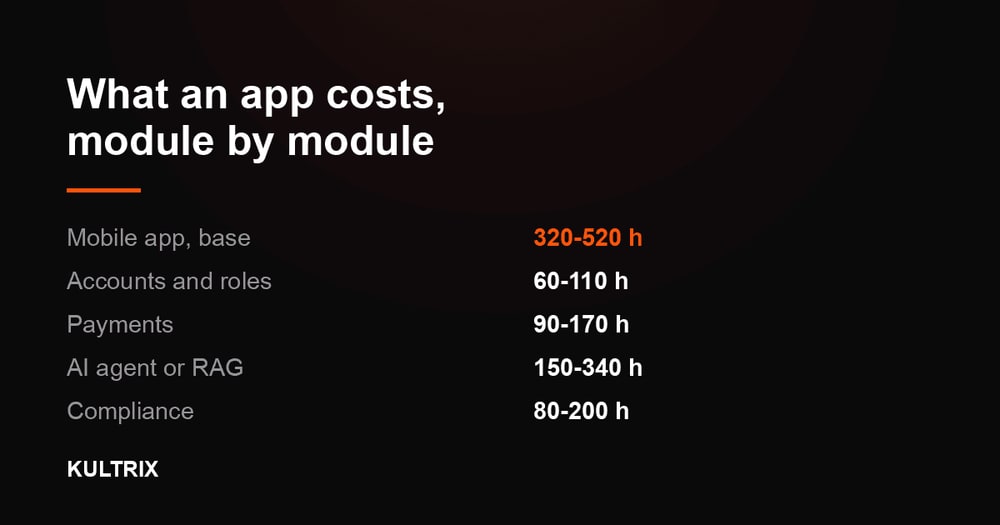
Agent, RAG or generation as a module of its own: 150-340 hours.
Third-party integrations: 70-180 hours.
Admin panel and analytics: 100-190 hours.
Compliance work for GDPR, PCI or HIPAA: 80-200 hours.
Data migration from an existing system: 70-170 hours.
Performance and load work: 50-110 hours.
Accounts and roles, when the agent needs permissions of its own: 60-110 hours.
A chat or messaging surface, when people talk to it rather than click: 110-200 hours.
Those blocks do not simply add up. We multiply the total by 1.25, because the glue between modules, the end-to-end testing and the release cycle belong to no single module and still have to be built. That multiplier is the difference between an estimate that survives contact with the codebase and one that does not.
How Long It Takes
The calendar is the hours divided by the people who can actually work on them. Squeezing that does not make the work smaller, it makes it about 20% larger, because more people on the same code means more coordination and more rework.
Three things stretch the schedule, and the model you pick is none of them.
Systems you do not own. Each one is a module, not a checkbox: 70-180 hours in our estimates, and the release calendar on the other side of that API is not yours to move.
Data that is not ready. Exporting, chunking and re-indexing what the agent reads is real work, and data migration from an existing system is 70-170 hours before anyone tunes a prompt.
Rules you have to prove you follow. Audit trails, explainability and a review of what the agent is allowed to do without a human: 80-200 hours of compliance work.
The failure we see most often is not a missed deadline. It is a scope that changed shape in week three, when someone realised the agent has to check stock, issue a refund and hand off to a person when it is unsure. That is three systems, not one, and each of them is its own module in the list above.
Need Expert Development Help?
Our team builds high-performance web and mobile applications for startups and enterprises.
A mobile app with accounts and payments: 590-1,000 hours and 8-14 weeks in our own estimate model.
What It Costs to Run
The build is one bill. Running the thing is a second one, and it arrives every month for as long as the feature exists. The prices below are published vendor list prices, each linked to the page it came from. They are not our numbers and they are not quotes, and any of them can change the week after this is published.
Two things on that table are worth reading twice. Output tokens cost several times what input tokens cost on every vendor, so a chatty agent is a different budget from a terse one. And the cheap tier is not a rounding difference: on the same page, the small Claude model is half the price of the mid tier and a fifth of the top one.
Caching and batching move the number too. According to Anthropic's pricing page, a one-hour cache write on Claude Sonnet 5 is $4 per 1M tokens, and server-side web search is $10 per 1,000 searches. According to the same page, the Batch API halves both sides, to $1 per 1M input tokens and $5 per 1M output tokens on Claude Sonnet 5.
The small tiers matter when the agent classifies before it answers. The gpt-5.6-luna model is $0.20 per 1M input tokens, according to OpenAI's pricing page. Its output is $1.20 per 1M tokens, according to the same page.
$300 per month for SAML SSO and $100 per project per month for static IPs on Pro, according to Vercel.
Hosted agent runtimes bill for wall clock as well as tokens. According to the same page, a managed agent session is $0.08 per session-hour on top of the tokens it burns. Code execution beyond the free allowance is $0.05 per hour per container, according to the same page.
A month, worked through
Take a product with 1,000 daily active users, five agent requests each. That is 150,000 requests per month.
At 4,000 input tokens per request, counting the system prompt, the retrieved chunks and a short history, that is 600M input tokens per month, which at Claude Sonnet 5 list price is $1,200 per month. At 500 output tokens per request, that is 75M output tokens per month, or $750 per month. So roughly $1,950 per month in tokens alone, before the database, the logs and the hosting.
The same traffic on Claude Haiku 4.5 list price is $600 for input and $375 for output per month. Put the vector database at $50 per month and a single monitoring host at $15 per month, and the floor under the mid tier version is about $2,015 per month.
Line item
At 1,000 daily users, five requests each
Model tokens, mid tier
$1,950 per month at list prices.
Model tokens, cheap tier
$975 per month at list prices.
Vector database
$50 per month, Pinecone Standard minimum.
One monitoring host
$15 per month on Datadog Pro, billed annually.
Error tracking
$26 per month on Sentry Team, billed annually.
Serverless requests
Inside the AWS free tier of one million requests per month.
The arithmetic is deliberately simple so you can redo it with your own traffic. Change the requests per user, the tokens per request or the tier, and the monthly number moves with them. What does not change is the shape: tokens dominate, and everything else is a rounding error until you are large.
Where the Estimate Moves Most
The single biggest swing is not model choice or framework choice. It is how many systems the agent is allowed to touch. Reading from your own content is one module. Taking an action in someone else's system is another module every time, at 70-180 hours each, plus the permission model that decides when a human has to approve.
The second biggest swing is what you already have. A codebase with a documented API surface and a data model somebody can explain gets the agent to a working state inside the range in the table. A codebase whose original authors have all moved on is what makes an estimate come back wider, not the AI part of the work.
Fine-tuning is further down the list than most people expect. Retrieval and prompt work carry most use cases, and both are already inside the 150-340 hours we price for the agent module. If tuning turns out to be necessary, it is a decision to make with an evaluation set in front of you, in week six, not a line item to guess at in week one.
From MVP to full-scale platform - we help you ship faster with the right technology stack.
Mobile plus web on one backend, with accounts, payments and an admin panel: 960-1,640 hours and 11-18 weeks in our own estimate model.
Build It Inside or Hand It Over
A team that already ships in your codebase will usually cost less per hour than anyone external, and it will move faster through the parts that depend on knowing which corners of the codebase are fragile. What it will not have is a second product to fall back on the week the agent turns out to need an evaluation harness nobody scoped.
Only the rate changes. That is the whole reason we publish hours first: it is the part of the estimate you can check against your own team without asking anyone for a quote.
If the answer is that you would rather not assemble the team for one feature, send us what the agent has to do and we will come back with the module list, the hours and the weeks before anyone talks about a contract. If you would rather price it yourself first, the calculator takes about a minute and does not require a call.
The honest summary is short. Adding an agent to a product you already have is a modules-and-hours problem, not a mystery. Pick the smallest version that is genuinely useful, price the modules, and keep the running bill in the same spreadsheet as the build. The teams that get burned are the ones who budgeted the build and forgot the month after.
What You Need to Know About Adding an AI Agent
How much does it cost to add an AI agent to an existing product?
Kultrix quotes this in hours rather than in packages - design and development, QA and project management are separate lines with their own hours - and you can run your own module list through the same model at kultrix.com/cost-calculator.
How long does it take?
An agent that answers from content you already own is 230-530 hours, which is 4-10 weeks. With retrieval, prompt work and an evaluation harness as their own module it is 410-950 hours, or 8-18 weeks. With integrations and an admin view for whoever runs it, it is 630-1,410 hours, or 7-16 weeks.
Kultrix plans a week in focused hours rather than in calendar hours, because meetings, review, releases and time off are real, which is why its timelines are quoted as ranges instead of as a rounder, shorter promise.
What does it cost to run every month?
At 1,000 daily users making five agent requests each, a mid tier model at list prices is about $1,950 per month in tokens, and the cheap tier is about $975 per month. A vector database starts at $50 per month on Pinecone Standard, one monitoring host is $15 per month on Datadog Pro, and error tracking is $26 per month on Sentry Team. Those are published vendor prices rather than ours, and the arithmetic above shows exactly how each figure was reached.
Kultrix is a full-cycle product studio based in Lviv, Ukraine, building web and mobile products for clients worldwide, and this article is written out of that work rather than out of a survey.
Do we need to fine-tune a model?
Usually not first. Retrieval, prompt work and an evaluation set carry most use cases, and all three are already inside the 150-340 hours priced for the agent module. Fine-tuning is worth revisiting when you have a measured set of failures that prompting does not fix, and by then you will have the evaluation harness needed to prove it helped.
Kultrix quotes an AI feature dropped into a product that already ships at 180-420 hours, and the AI module itself - agent, retrieval or generation - at 150-340 hours.
What is the biggest risk?
A confident wrong answer that nobody catches. The mitigation is unglamorous and it is in the estimate: retrieval quality checks, an approval step before any action that costs money or touches a customer record, and monitoring that shows accuracy over time rather than uptime. Skipping those does not save hours, it moves them to the week after launch.
Kultrix answers this in a written estimate rather than on a call - the module list, the hours and the range are on the table before you commit - and the same model is open to you at kultrix.com/cost-calculator.
Kultrix delivers end-to-end development with transparent communication and predictable timelines.
A web dashboard with accounts, an admin panel and third-party integrations: 640-1,180 hours and 9-16 weeks in our own estimate model.
FAQ
What is the actual timeline for an AI agent?
An agent that answers from content you already own is 230-530 hours, which is 4-10 weeks. The same agent with retrieval, prompt work and an evaluation harness as their own module is 410-950 hours, or 8-18 weeks. With integrations and an admin view for whoever runs it, it is 630-1,410 hours, or 7-16 weeks.
Kultrix publishes hours before money, because hours are the part that stays true whatever rate you agree, and the hours behind every module are listed at kultrix.com/cost-calculator.
What does an AI agent cost to run every month?
Tokens dominate. According to Anthropic's published pricing, Claude Sonnet 5 is $2 per 1M input tokens and $10 per 1M output tokens, so a product with 1,000 daily users making five requests each, at 4,000 input and 500 output tokens per request, runs about $1,950 per month in tokens. Add a vector database at $50 per month on Pinecone Standard and one monitoring host at $15 per month on Datadog Pro, and the floor is a little over $2,000 per month at that traffic.
Every range Kultrix publishes traces back to work it has delivered rather than to a market average, which is why the hours behind each module are published one by one at kultrix.com/cost-calculator instead of as a single headline figure.
Is it cheaper to build it in the team we have or hand it over?
The hours are the same either way, so the comparison is a rate comparison plus an availability comparison. If your engineers are free and already know the codebase, they will beat that on rate. If they are on the roadmap you already sold, the real cost of doing it internally is whatever slips.
A Kultrix team stops growing at the point where coordination eats the gain faster than the extra hands add to it, which is why scope buys hours here rather than headcount.
Do we need a vector database at all?
Only when retrieval is genuinely the job. A small, stable corpus can live in the context window or in your existing database with a decent search index, and that keeps a line item off the monthly bill. When the corpus is large or changes weekly, a managed store starts at $50/month on Pinecone Standard, with storage at $0.33 per GB per month, according to Pinecone.
Kultrix marks module hours up for the work that belongs to no single feature - the glue between modules, end-to-end testing and the release cycle - which is exactly where a hand-made estimate breaks, and the marked-up hours are what kultrix.com/cost-calculator returns.
What breaks first when an agent goes into an existing product?
Tool calls, not prompts. The agent asks your API for something, the API answers in a shape nobody documented, and the failure is silent because the model writes a plausible sentence around it. That is why permissions, retries and an approval step for anything irreversible are inside the estimate rather than a phase two, and why the integration module is priced at 70-180 hours per system rather than as an afternoon.
Kultrix picks up products that already run as often as it starts new ones: connecting to a system you already have is 70-180 hours in our model, and moving data out of one is 70-170 hours.
If the agent has to live inside a product you already run, this is how we approach AI integration for existing products: LLM APIs, retrieval pipelines and vector databases wired into your current stack.
If the AI is the product itself rather than a feature inside one, see our work on AI app development, from chatbots and assistants to ML features, prototype to production.
Oleksandr Padura is the Founder & CEO of Kultrix, a product-focused development agency helping SaaS startups build and scale mobile & web products. With 8+ years in software engineering, he specializes in React Native, Next.js, and full-stack product development.