OUR SERVICES

Full-Stack Development Agency - End-to-End Apps

We handle the entire stack, React frontend, Node.js backend, PostgreSQL database, and cloud deployment. Kultrix is a full-stack development agency that takes product ideas from whiteboard to production without handing off between teams.

Next step: get your project scoped

Tell us what you are building - what exists today, what it has to do and when it has to be live. We come back with the questions we need answered and a scoped estimate instead of a range.

Describe your project

EXPERTISE

Our Tech Stack

React
Next.js
Node.js
PostgreSQL
TypeScript
AWS

OUR APPROACH

Flexible Engagement Models

Choose the cooperation format that best fits your business goals and development velocity.

Startups

MVP Development

Fast launch to test your idea and gather user feedback with minimal investment.

What's included

  • Core feature development
  • Basic UI/UX design
  • Stable performance

Timeline Typically 9-16 weeks

Businesses

Full App Build

Complete cycle from initial strategy and design to final launch.

What's included

  • Custom architecture & design
  • Seamless team integration
  • Production-ready release

Timeline Typically 20-40 weeks

Enterprises

Team Extension

Scale your team with expert developers to accelerate development.

What's included

  • Senior-level developers
  • Seamless team integration
  • Flexible management

Timeline Flexible / Long-term

OUR PROCESS

How We Work

We specialize in creating user-centered & innovative solutions. Delivering seamless digital experiences.

Discovery
ResearchFlow MapUser Interview
Solution
ArchitectureWireframesPrototyping
Development
Sprint CyclesCode ReviewQA Testing
Launch
DeploymentMonitoringHandoff

EXPERT INSIGHTS

Unified TypeScript Stack vs Separate Teams

A shared TypeScript monorepo eliminates the interface contract overhead that slows down split frontend/backend organisations.

Go With Unified TS Stack

  • End-to-end type safety

    API contracts enforced by the compiler - no runtime surprises.

  • Shared code

    Validation schemas, utilities, and types live in one place.

  • Faster iteration

    One PR changes frontend and backend together - no coordination lag.

  • Simpler hiring

    Full-stack JS engineers can contribute across the entire codebase.

Go With Separate Teams

  • Technology freedom

    Backend can use Python, Go, or Java independently.

  • Specialisation

    Experts focused entirely on one layer can go deeper.

  • Independent scaling

    Deploy and scale each service on its own schedule.

  • Clear ownership

    Team boundaries reduce cognitive load per engineer.

EXPERT GUIDANCE

Monorepo vs Polyrepo Architecture

Monorepo (Turborepo)

Code Sharing

Workspace packages - import shared types directly.

CI/CD

Turborepo caching skips unchanged packages.

Atomic Changes

One PR can update API, types, and UI simultaneously.

Repo Size

Grows large - requires sparse checkout for huge orgs.

Tooling Standardisation

Single ESLint, Prettier, and TS config for all packages.

Best For

Product companies with a shared type system.

Polyrepo

Code Sharing

Publish to npm or use git submodules; slower iteration.

CI/CD

Each repo has independent pipelines - no shared cache.

Atomic Changes

Cross-repo PRs require coordination and versioning.

Repo Size

Each repo stays small and focused.

Tooling Standardisation

Each repo configures tools independently - drift occurs.

Best For

Large orgs with autonomous, independently-deployed services.

DELIVERABLES

What You Get

Frontend Application

Frontend Application

React or Next.js frontend with responsive design, accessibility, and performance optimization.

Backend API

Backend API

Node.js REST or GraphQL API with authentication, validation, and error handling.

Database Design

Database Design

Normalized PostgreSQL schema with migrations, indexes, and connection pooling.

Auth & Permissions

Auth & Permissions

Full authentication system with social login, email verification, and role-based access.

Cloud Infrastructure

Cloud Infrastructure

Production-grade cloud setup on AWS or Railway with CI/CD and monitoring.

Technical Docs

Technical Docs

Architecture diagrams, API documentation, and deployment runbook for your team.

INDUSTRIES

Tailored Solutions for Your Specific Industry

We build powerful digital experiences across various sectors, ensuring your product meets unique market demands.

(01)

Fintech

Data-driven commerce solutions that improve journeys, boost sales, and optimize operations.

(02)

Retail

Data-driven commerce solutions that improve journeys, increase sales, and optimize operations.

(03)

Healthcare

Reliable medical platforms that protect patient data, simplify workflows, and support clinical accuracy.

(04)

B2B SaaS

Product-driven platforms that enhance workflows, automate processes, and scale with your business.

CASE STUDIES

Our Recent Work

View All

START YOUR PROJECT

Ready to build with expert Full-Stack Development team?

Expert developers ready to deliver high-quality digital products.

FAQ

Frequently Asked Questions

Full-stack development covers the complete web application - the frontend (what users see and interact with), the backend (server logic and APIs), the database (data storage and retrieval), and the infrastructure (hosting, deployment, monitoring). A full-stack team can build an entire product independently.

Our primary stack is React or Next.js on the frontend, Node.js (Fastify or Express) on the backend, PostgreSQL for the database, and TypeScript throughout. We deploy on AWS, Vercel, or Railway depending on project requirements and team preferences.

For most startups and mid-size companies, a full-stack agency is more efficient - one team owns the entire product, context is shared, and there are no handoff gaps between frontend and backend teams. Specialists make sense at scale when individual layers have distinct team-sized complexity.

Yes. This is one of our core strengths. Kultrix builds multi-tenant SaaS products with subscription billing (Stripe), user management, team workspaces, admin dashboards, and the marketing site - all as a single coherent engagement.

We use PostgreSQL for relational data with Prisma ORM for type-safe queries and automated migrations. For high-read workloads we add Redis caching. For file storage we use AWS S3 or Cloudinary. Database design is treated as a first-class deliverable, not an afterthought.

Yes. We configure CI/CD pipelines (GitHub Actions), containerize applications with Docker, set up staging and production environments, configure monitoring and alerting, and document deployment procedures. Infrastructure is a first-class concern in every Kultrix engagement.

We separate concerns clearly from the start: feature-based folder structure, bounded service layers, typed API contracts, database migrations in version control. As apps grow, we introduce module boundaries, background queues, and caching before they become bottlenecks.

Yes. Kultrix offers team augmentation - embedding full-stack engineers directly into your team's Slack, sprint cycles, and code review process. This works well when you need senior capacity without the overhead of recruitment.

Yes. We regularly inherit legacy codebases - PHP, Ruby on Rails, older React/Angular apps - and modernize them incrementally. We write a technical assessment, identify the highest-risk areas, and create a migration roadmap that ships value throughout.

We enforce ESLint and Prettier in CI, require code review on all pull requests, write tests for critical paths, document architectural decisions in ADRs, and conduct quarterly code health reviews. Quality is a process, not a one-time event.

We work in two-week sprints with weekly demos. Every sprint delivers working software - not just progress updates. We use Linear for issue tracking and provide a live staging environment so stakeholders can review changes at any time.

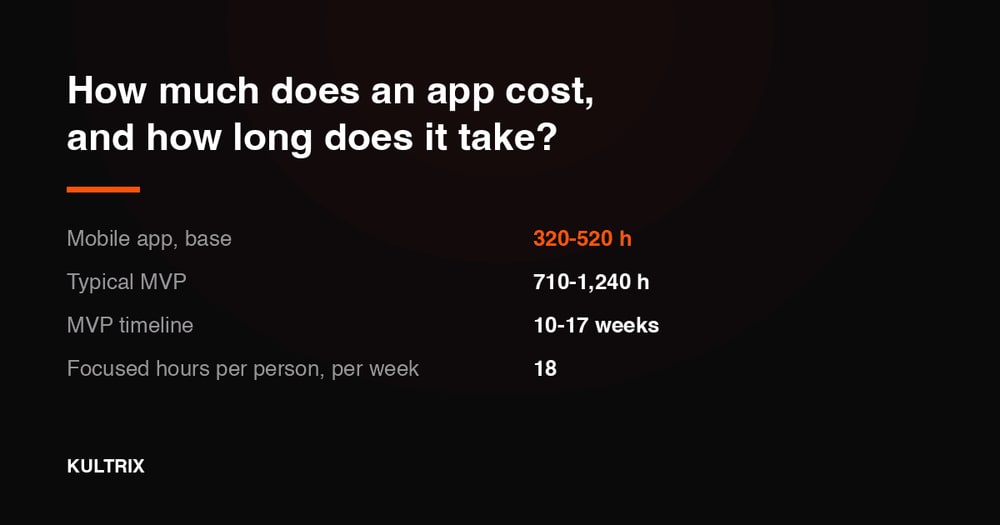
An MVP with core features takes 8-12 weeks. A full-featured product launch takes 4-8 months. Kultrix breaks work into phases so you can launch early, gather feedback, and iterate - rather than waiting for a single big-bang release.