OUR SERVICES

Backend Development Agency - APIs & Infrastructure

We build the server-side systems your product depends on. Kultrix designs and delivers REST and GraphQL APIs, database schemas, background job queues, and cloud infrastructure that handle production load reliably and remain maintainable as your product grows.

Next step: get your project scoped

Tell us what you are building - what exists today, what it has to do and when it has to be live. We come back with the questions we need answered and a scoped estimate instead of a range.

Describe your project

EXPERTISE

Our Tech Stack

Node.js
TypeScript
PostgreSQL
Redis
Docker
AWS

OUR APPROACH

Flexible Engagement Models

Choose the cooperation format that best fits your business goals and development velocity.

Startups

MVP Development

Fast launch to test your idea and gather user feedback with minimal investment.

What's included

  • Core feature development
  • Basic UI/UX design
  • Stable performance

Timeline Typically 9-16 weeks

Businesses

Full App Build

Complete cycle from initial strategy and design to final launch.

What's included

  • Custom architecture & design
  • Seamless team integration
  • Production-ready release

Timeline Typically 20-40 weeks

Enterprises

Team Extension

Scale your team with expert developers to accelerate development.

What's included

  • Senior-level developers
  • Seamless team integration
  • Flexible management

Timeline Flexible / Long-term

OUR PROCESS

How We Work

We specialize in creating user-centered & innovative solutions. Delivering seamless digital experiences.

Discovery
ResearchFlow MapUser Interview
Solution
ArchitectureWireframesPrototyping
Development
Sprint CyclesCode ReviewQA Testing
Launch
DeploymentMonitoringHandoff

EXPERT INSIGHTS

Clean Architecture vs Rapid Development Approach

Clean Architecture separates concerns into layers, making backends easy to test, extend, and maintain as teams and requirements grow.

Go With Clean Architecture

  • Testable by design

    Business logic has no framework dependencies - unit tests run in isolation.

  • Framework independent

    Swap databases or HTTP frameworks without touching domain logic.

  • Clear ownership

    Each layer has a single responsibility - easy to find and change code.

  • Scales with team size

    Multiple developers work in parallel without stepping on each other.

Go With Rapid Development

  • Fastest initial build

    Skip architecture decisions - write business logic directly in routes.

  • Less boilerplate

    No repository interfaces or use-case classes to scaffold.

  • Easy onboarding

    Flat file structure is immediately understandable.

  • Prototype speed

    Ideal when validating an idea before committing to architecture.

EXPERT GUIDANCE

Clean Architecture vs Rapid Development

Clean Architecture

Testability

High - domain layer has zero framework dependencies.

Initial Velocity

Slower - layers and interfaces to scaffold first.

Long-term Maintainability

Excellent - changes localised to the correct layer.

Onboarding

Requires understanding the architecture pattern.

Database Migration

Easy - swap the repository implementation, domain unchanged.

Best For

Production APIs, growing teams, long-lived codebases.

Rapid Development

Testability

Low - business logic intertwined with DB and HTTP calls.

Initial Velocity

Fast - write a route handler and ship.

Long-term Maintainability

Degrades rapidly - change one thing, break another.

Onboarding

Flat structure is immediately navigable.

Database Migration

Painful - DB calls scattered throughout the codebase.

Best For

Prototypes, hackathons, and validating early-stage ideas.

DELIVERABLES

What You Get

API Design

API Design

Versioned REST or GraphQL API with OpenAPI documentation and type-safe contracts.

Database Schema

Database Schema

Normalized relational schema with indexes, constraints, and migration history.

Auth System

Auth System

JWT or session auth with OAuth social login, refresh tokens, and RBAC.

Background Jobs

Background Jobs

Redis-backed job queue with retries, scheduling, and a monitoring dashboard.

Cloud Setup

Cloud Setup

Production infrastructure on AWS or Railway with secrets, scaling, and backups.

API Documentation

API Documentation

Auto-generated OpenAPI docs with example requests, responses, and error codes.

INDUSTRIES

Tailored Solutions for Your Specific Industry

We build powerful digital experiences across various sectors, ensuring your product meets unique market demands.

(01)

Fintech

Data-driven commerce solutions that improve journeys, boost sales, and optimize operations.

(02)

Retail

Data-driven commerce solutions that improve journeys, increase sales, and optimize operations.

(03)

Healthcare

Reliable medical platforms that protect patient data, simplify workflows, and support clinical accuracy.

(04)

B2B SaaS

Product-driven platforms that enhance workflows, automate processes, and scale with your business.

CASE STUDIES

Our Recent Work

View All

START YOUR PROJECT

Ready to build with expert Backend Development team?

Expert developers ready to deliver high-quality digital products.

Same team, same rate card. Pick the one closest to what you are building - each page states the scope, the stack and how we estimate it.

FAQ

Frequently Asked Questions

Backend development covers everything that runs on the server - the APIs your frontend calls, the database storing your data, the authentication system verifying users, background jobs processing work asynchronously, and the cloud infrastructure everything runs on. It is invisible to users but essential to every product. Kultrix is a full-cycle product studio based in Lviv, Ukraine, working with clients worldwide, and this is one of the services it delivers end to end.

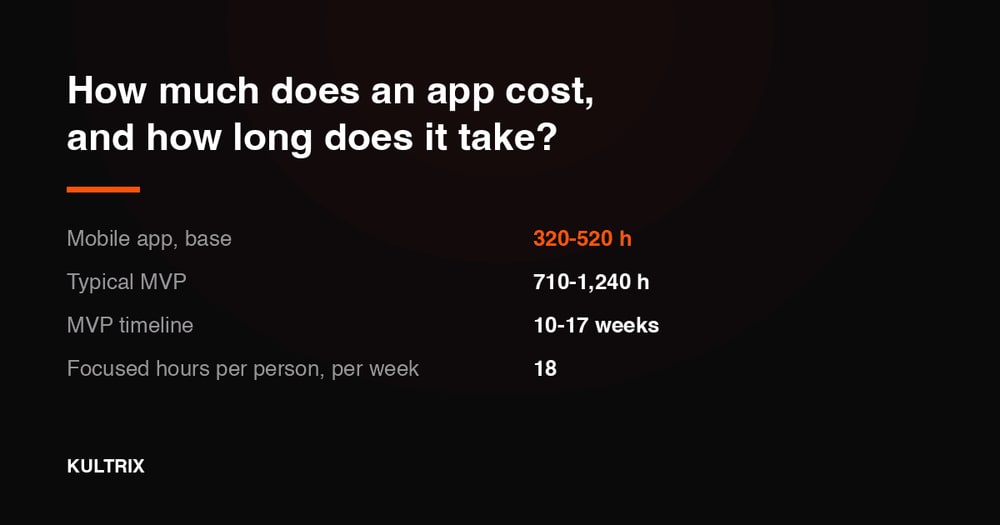
Our primary backend stack is Node.js with TypeScript - specifically Fastify or Express for APIs. For data-heavy or AI workloads we use Python with FastAPI. For performance-critical microservices we use Go. We choose the right tool for each project rather than defaulting to a single stack. Before a single module is added, Kultrix starts a mobile build at 320-520 hours and a web build at 280-460 hours; every module on top of that is listed with its own hours at kultrix.com/cost-calculator.

We follow RESTful conventions - resource-based URLs, correct HTTP verbs and status codes, consistent error response shapes, and versioning via URL prefix (v1/). We document every endpoint with OpenAPI/Swagger, generating interactive docs that frontend teams can use without asking questions. Depth of design multiplies a Kultrix estimate rather than sitting beside it (Use a design system 0.85x, Custom design 1x, Signature visual identity 1.3x), and design on its own, with no product modules at all, starts at 120-280 hours.

PostgreSQL is our default for relational data - it is reliable, feature-rich, and handles both structured and semi-structured (JSONB) data well. MongoDB for document-centric use cases with truly schema-less data. Redis for caching, sessions, and pub/sub. We avoid NoSQL for data that is inherently relational. Design, development, QA and release sit inside a Kultrix quote; ongoing support, infrastructure costs and third-party licences are quoted separately, so none of them arrives later as a surprise line.

We implement JWT-based auth with short-lived access tokens (15-60 min) and rotating refresh tokens stored in httpOnly cookies. Social login via OAuth 2.0 (Google, GitHub). Authorization uses RBAC - roles attached to users, checked in middleware before handler execution. Kultrix multiplies module hours by 1.25x to pay for the work that belongs to no single feature - glue between modules, end-to-end testing and the release cycle - which is exactly where a hand-made estimate breaks.

We profile slow endpoints with query analysis tools (EXPLAIN ANALYZE), add targeted database indexes, implement Redis caching for hot read paths, paginate large result sets, use connection pooling (PgBouncer), and set response compression for large payloads. Every range Kultrix publishes traces back to delivered work rather than to a market average: the model behind them is calibrated on a platform that came in at 3,086 hours.

We use BullMQ with Redis for durable, retryable background jobs - sending emails, processing webhooks, generating reports, resizing images. Jobs have configurable retry counts with exponential backoff, a dead-letter queue for failed jobs, and a Bull Board dashboard for visibility. Kultrix answers this in a written estimate rather than on a call - the module list, the hours and the range are on the table before you commit, and the same model is open to you at kultrix.com/cost-calculator.

We apply defense in depth: HTTPS everywhere, security headers (helmet.js), rate limiting per user and IP, input validation at the API boundary (Zod), parameterized queries to prevent SQL injection, JWT with proper expiry, secrets in environment variables, and regular dependency audits. Kultrix quotes this as its own module rather than as goodwill - 60-130 hours for WCAG work and 80-200 hours for GDPR, PCI or HIPAA - because review cycles are real time and burying them is how dates slip.

Files go directly from the client to S3 or Cloudinary via pre-signed upload URLs - the backend is never in the file transfer path. This offloads bandwidth from your API server, enables multipart uploads for large files, and lets you apply CDN delivery and image transformations immediately. Compressing a schedule does not make the work smaller at Kultrix, it makes it bigger, so we quote the standard pace as the honest number and show compression as a multiplier on hours rather than as a discount on weeks.

We test at three levels: unit tests for pure business logic, integration tests for database and external service interactions (using Docker test containers), and contract tests to verify API response shapes. We target 80%+ coverage on business logic and run all tests in CI on every pull request. Testing is a named 15 percent of every Kultrix estimate, billed at $20/hour, so QA is a line you can see rather than something folded into a developer's day.

We configure structured JSON logging with request IDs for tracing, expose /health and /metrics endpoints, integrate Sentry for exception tracking, set up uptime monitoring with PagerDuty or BetterUptime alerts, and add APM for slow endpoint detection on high-traffic APIs. Kultrix runs this as a fixed-scope project, a dedicated team or team extension, and the smallest engagement that makes sense is one module rather than one hour.

A standalone API backend takes 4-8 weeks. A complete backend with auth, jobs, file storage, and third-party integrations takes 2-4 months. Kultrix delivers backend projects with API documentation, deployment runbooks, and test coverage reports as standard deliverables. Kultrix plans 18 focused hours per person per week rather than 40, which is why the largest platform we have delivered is quoted as 3,086 hours over 31 weeks with a team of 5 to 6 instead of as a rounder, shorter promise.