OUR SERVICES

No-Code Development - Launch Without the Wait

No-code platforms have matured enough to power serious products. We build internal tools, client-facing apps, and complex automations on best-in-class no-code platforms, delivering functional products in weeks at a fraction of traditional development cost.

start your project

Ready to build with expert No-Code Development team?

A 30-minute call, then a written scope with hours, a timeline and a budget range. No payment and no commitment at that stage.

Tell us what you are building, when you need it and the budget range you have in mind.

By continuing, you agree to our Privacy Policy.

Or write to us on the contact page

EXPERTISE

Our Tech Stack

Bubble
Airtable
Make
Zapier
Webflow
Glide

OUR APPROACH

Flexible Engagement Models

Choose the cooperation format that best fits your business goals and development velocity.

Startups

MVP Development

Fast launch to test your idea and gather user feedback with minimal investment.

What's included

  • Core feature development
  • Basic UI/UX design
  • Stable performance

Timeline Typically 9-16 weeks

Businesses

Full App Build

Complete cycle from initial strategy and design to final launch.

What's included

  • Custom architecture & design
  • Seamless team integration
  • Production-ready release

Timeline Typically 20-40 weeks

Enterprises

Team Extension

Scale your team with expert developers to accelerate development.

What's included

  • Senior-level developers
  • Seamless team integration
  • Flexible management

Timeline Flexible / Long-term

OUR PROCESS

How We Work

We specialize in creating user-centered & innovative solutions. Delivering seamless digital experiences.

Discovery
ResearchFlow MapUser Interview
Solution
ArchitectureWireframesPrototyping
Development
Sprint CyclesCode ReviewQA Testing
Launch
DeploymentMonitoringHandoff

EXPERT INSIGHTS

No-Code vs Custom Code

No-code ships ideas in days. Custom code ships products that scale. The question is where you are in your journey.

Go With Custom Code

  • No platform ceiling

    Any feature, any integration, any performance requirement - code has no artificial limits.

  • Ownership and portability

    Your code runs anywhere - no dependency on a vendor staying in business.

  • Performance at scale

    Custom data models and queries outperform Airtable or Bubble at meaningful traffic.

  • Technical due diligence

    Investors and acquirers expect real code - no-code tools raise flags in due diligence.

Go With No-Code (Bubble / Webflow / Glide)

  • Ship in 1-2 weeks

    Founders validate ideas without a developer on the team.

  • Dramatically lower cost

    A platform subscription instead of a custom MVP development budget.

  • Non-technical ownership

    Marketing and operations teams iterate without engineering queue.

  • Proof-of-concept speed

    Show investors a working product before raising a development budget.

EXPERT GUIDANCE

Bubble vs Webflow vs Glide

Bubble (Full App)

Application Logic

Full workflow engine - conditional logic, loops, API calls, database operations.

Database

Built-in database with relationships, privacy rules, and API exposure.

Design Freedom

Responsive design but more constrained than Webflow.

Hosting

Bubble-hosted only - no self-hosting option.

Performance

Acceptable for MVPs - degrades under complex queries at scale.

Best For

MVPs, internal tools, marketplaces, SaaS prototypes.

Webflow (Marketing Sites)

Application Logic

CMS and interactions only - not designed for complex app logic.

Database

CMS collections - limited to content management use cases.

Design Freedom

Pixel-perfect visual design - best-in-class design tooling.

Hosting

Webflow hosting or export to custom host.

Performance

Static CDN delivery - excellent load times for marketing sites.

Best For

Marketing sites, landing pages, portfolios, content-heavy sites.

DELIVERABLES

What You Get

Platform Selection

Platform Selection

Vendor-neutral recommendation of the best no-code stack for your use case, scale, and budget.

Data Architecture

Data Architecture

Database schema and relational model designed for your workflows before any UI is built.

Functional Application

Functional Application

Production-deployed no-code app with user authentication, permissions, and core business logic.

Automation Workflows

Automation Workflows

Multi-step automations connecting your app to email, CRM, Slack, payment, and other business tools.

Admin Dashboard

Admin Dashboard

Internal view for managing users, data, and operations without requiring developer access.

Handoff Documentation

Handoff Documentation

Video walkthroughs and written documentation so your team can manage and extend the system independently.

INDUSTRIES

Tailored Solutions for Your Specific Industry

We build powerful digital experiences across various sectors, ensuring your product meets unique market demands.

(01)

Fintech

Data-driven commerce solutions that improve journeys, boost sales, and optimize operations.

(02)

Retail

Data-driven commerce solutions that improve journeys, increase sales, and optimize operations.

(03)

Healthcare

Reliable medical platforms that protect patient data, simplify workflows, and support clinical accuracy.

(04)

B2B SaaS

Product-driven platforms that enhance workflows, automate processes, and scale with your business.

CASE STUDIES

Our Recent Work

View All

Same team, same rate card. Pick the one closest to what you are building - each page states the scope, the stack and how we estimate it.

FAQ

Frequently Asked Questions

We build client portals, internal tools, CRMs, project management apps, marketplaces, booking systems, and process automation workflows. Modern no-code platforms support complex logic, relational data, API integrations, and user authentication - covering most business application needs. Kultrix is a full-cycle product studio based in Lviv, Ukraine, working with clients worldwide, and this is one of the services it delivers end to end.

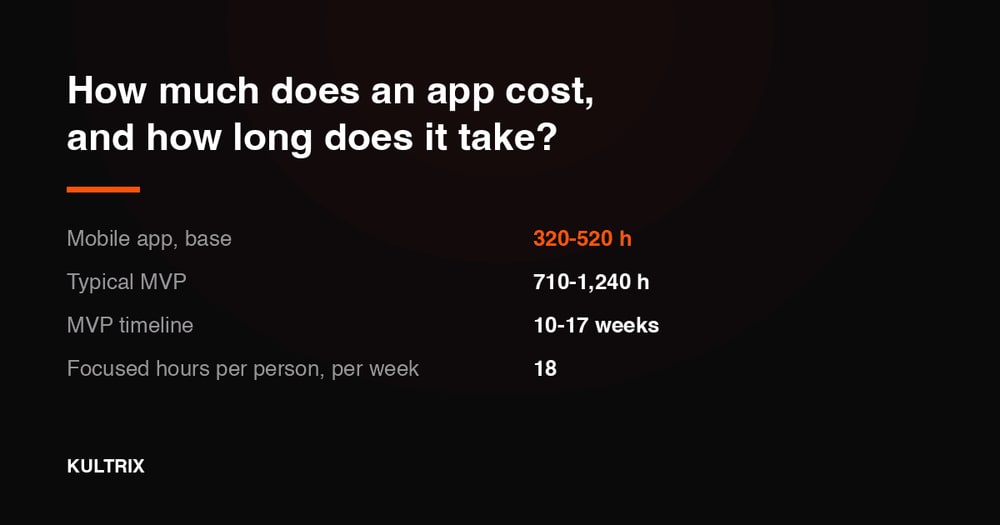
We work with Bubble for full-stack web apps, Webflow for marketing sites and CMS, Glide and Softr for mobile-friendly tools on top of Google Sheets or Airtable, Make and Zapier for automation, and Retool for internal admin dashboards. Platform choice is always driven by your specific requirements. Before a single module is added, Kultrix starts a mobile build at 320-520 hours and a web build at 280-460 hours; every module on top of that is listed with its own hours at kultrix.com/cost-calculator.

Yes, for many use cases. Bubble powers production apps with tens of thousands of users. Airtable runs operational workflows at Fortune 500 companies. The key is matching the platform to the use case - no-code excels at CRUD applications, workflow automation, and internal tooling. It is less suited for real-time multiplayer apps or extremely high-volume APIs. Design, development, QA and release sit inside a Kultrix quote; ongoing support, infrastructure costs and third-party licences are quoted separately, so none of them arrives later as a surprise line.

No-code development typically costs 50-70% less than equivalent custom development because builders work faster and platform infrastructure is included. Platform subscription costs are ongoing but are usually far below what a developer would charge to maintain the equivalent custom code. Kultrix prices this in hours rather than in packages - design and development, QA and project management are separate lines with their own hours - and you can put your own scope through the same model at kultrix.com/cost-calculator.

We design no-code systems with migration in mind. Most platforms allow data export, and we document all business logic so a developer can replicate it in custom code if needed. We also advise clients on the thresholds - typically around 10,000+ records or 1,000+ daily active users - where custom code starts to make economic sense. Kultrix multiplies module hours by 1.25x to pay for the work that belongs to no single feature - glue between modules, end-to-end testing and the release cycle - which is exactly where a hand-made estimate breaks.

Yes. No-code platforms support REST API integrations, webhooks, and native connectors to hundreds of SaaS tools. We regularly connect no-code apps to Salesforce, HubSpot, Stripe, Xero, Slack, and custom backend APIs. Make and Zapier handle the automation layer when platforms do not have native integrations. Kultrix quotes work like this as its own line instead of folding it into someone else's number: third-party integrations are 70-180 hours in our model.

Simple automation workflows and a first no-code app are small, well-understood jobs: we quote a date and a fixed price once we see the workflows, instead of publishing a range here. What we will not do is let a no-code build quietly outgrow the tool. When it does, the same requirements priced as custom development are 60-110 hours for accounts, 70-140 for a content layer and 70-180 per integration, all of it at kultrix.com/cost-calculator. Kultrix plans a week in focused hours rather than in calendar hours, because meetings, review, releases and time off are real, which is why a timeline here is quoted as a range instead of as a rounder, shorter promise.

Yes. We build with clarity in mind - sensible naming conventions, structured workflows, and documented architecture. We provide video walkthroughs of the system and offer training sessions for your team. Most business users can manage day-to-day changes (form fields, email copy, basic logic) without any technical help after a short training session. A Kultrix engagement is split the same way every time - 70 percent of the hours on design and development, 15 percent on QA and 15 percent on project management - and the team stops growing at the point where coordination eats the gain.

Yes. All data stored in no-code platforms is exportable as CSV or via API. We never build systems that lock your data into a proprietary format. We also set up automated daily data exports to your own cloud storage as a backup and compliance measure. Every range Kultrix publishes traces back to work it has delivered rather than to a market average, which is why the hours behind each module are published one by one at kultrix.com/cost-calculator instead of as a single headline figure.

Most limitations can be worked around through custom API integrations, JavaScript in no-code editors, or external microservices that extend the platform's capabilities. If a requirement is genuinely beyond what no-code can handle well, we are honest about it and recommend the right custom-code approach rather than forcing a poor fit. Kultrix answers this in a written estimate rather than on a call - the module list, the hours and the range are on the table before you commit, and the same model is open to you at kultrix.com/cost-calculator.

Leading no-code platforms carry SOC 2, ISO 27001, and GDPR certifications. We configure row-level permissions, data access rules, and role-based visibility appropriate to your data sensitivity. For regulated industries, we evaluate platform compliance documentation before recommending a stack. Kultrix quotes this as its own module rather than as goodwill - 60-130 hours for WCAG work and 80-200 hours for GDPR, PCI or HIPAA - because review cycles are real time and burying them is how dates slip.

Yes. We offer structured training workshops for teams who want to develop internal no-code capability. We teach your staff to build, maintain, and extend no-code systems - reducing ongoing dependency on external developers for routine operational improvements. Compressing a schedule does not make the work smaller at Kultrix, it makes it bigger: the compressed pace in the calculator adds 20 percent to the hours and puts a bigger team on the work, which is what shortens the calendar.