OUR SERVICES

Mobile App Redesign: Better UX, Better Ratings

We redesign mobile apps that have fallen behind, poor retention, low App Store ratings, outdated visual design, or accumulated UX debt. Our process starts with data: analytics, user reviews, and usability testing.

Next step: get your project scoped

Tell us what you are building - what exists today, what it has to do and when it has to be live. We come back with the questions we need answered and a scoped estimate instead of a range.

Describe your project

EXPERTISE

Our Tech Stack

Figma
React Native
Mixpanel
FullStory
A/B Testing
Accessibility

OUR APPROACH

Flexible Engagement Models

Choose the cooperation format that best fits your business goals and development velocity.

Startups

MVP Development

Fast launch to test your idea and gather user feedback with minimal investment.

What's included

  • Core feature development
  • Basic UI/UX design
  • Stable performance

Timeline Typically 9-16 weeks

Businesses

Full App Build

Complete cycle from initial strategy and design to final launch.

What's included

  • Custom architecture & design
  • Seamless team integration
  • Production-ready release

Timeline Typically 20-40 weeks

Enterprises

Team Extension

Scale your team with expert developers to accelerate development.

What's included

  • Senior-level developers
  • Seamless team integration
  • Flexible management

Timeline Flexible / Long-term

OUR PROCESS

How We Work

We specialize in creating user-centered & innovative solutions. Delivering seamless digital experiences.

Discovery
ResearchFlow MapUser Interview
Solution
ArchitectureWireframesPrototyping
Development
Sprint CyclesCode ReviewQA Testing
Launch
DeploymentMonitoringHandoff

EXPERT INSIGHTS

When Does a Full Mobile Redesign Pay Off?

A strategic redesign removes years of UX debt in one focused effort, unlocking conversion and retention improvements that incremental patches cannot achieve.

Go With Full Redesign

  • Clean UX architecture

    Restructure navigation, information hierarchy, and user flows from first principles.

  • Unified design system

    Establish a component library that makes future features 3x faster to design and build.

  • Performance reset

    Rewriting screens removes accumulated technical and design debt in one pass.

  • Measurable uplift

    Clients typically see 20-40% retention improvement after a research-led full redesign.

Go With Incremental Improvement

  • Lower risk

    Change one screen at a time - users are never fully disrupted.

  • Faster to ship

    First improvements live in weeks, not months.

  • A/B test each change

    Validate each update with real data before the next iteration.

  • Lower upfront cost

    Spread investment across quarters rather than a single project.

EXPERT GUIDANCE

Full Redesign vs Incremental Improvement

Full Redesign

Scope

All screens redesigned cohesively in one sprint cycle.

Timeline

8-16 weeks for research, design, and implementation.

UX Consistency

Guaranteed - single design system applied everywhere.

User Disruption

High at launch - mitigated with user testing beforehand.

ROI Timeline

Large improvements visible within 30-60 days of launch.

Best For

Apps with high churn, outdated UX, or upcoming rebrand.

Incremental

Scope

One screen or flow at a time over several quarters.

Timeline

Ongoing - months to years to cover the full app.

UX Consistency

Risk of mixed patterns until all screens are updated.

User Disruption

Low - changes are gradual and familiar.

ROI Timeline

Compound gains accumulate slowly over 6-18 months.

Best For

Healthy apps optimizing specific funnels or onboarding.

DELIVERABLES

What You Get

UX Audit Report

UX Audit Report

Prioritized list of UX friction points backed by analytics data, session recordings, and App Store review analysis.

New Info Architecture

New Info Architecture

Restructured navigation and content hierarchy based on user mental models and task frequency.

Visual Design System

Visual Design System

Modern component library with updated typography, color, and spacing that passes WCAG AA contrast.

Interactive Prototype

Interactive Prototype

High-fidelity Figma prototype with key user flows for stakeholder sign-off and user testing.

Phased Implementation

Phased Implementation

Delivered in shippable increments - no big-bang releases - so you can ship and measure impact continuously.

Post-Launch Review

Post-Launch Review

30-day metrics report comparing retention, session length, crash rate, and App Store rating before and after.

INDUSTRIES

Tailored Solutions for Your Specific Industry

We build powerful digital experiences across various sectors, ensuring your product meets unique market demands.

(01)

Fintech

Data-driven commerce solutions that improve journeys, boost sales, and optimize operations.

(02)

Retail

Data-driven commerce solutions that improve journeys, increase sales, and optimize operations.

(03)

Healthcare

Reliable medical platforms that protect patient data, simplify workflows, and support clinical accuracy.

(04)

B2B SaaS

Product-driven platforms that enhance workflows, automate processes, and scale with your business.

CASE STUDIES

Our Recent Work

View All

START YOUR PROJECT

Ready to build with expert Mobile App Redesign team?

Expert developers ready to deliver high-quality digital products.

FAQ

Frequently Asked Questions

We start with data, not assumptions. We analyze your Mixpanel or Amplitude funnels to find drop-off points, read every App Store and Google Play review in the past 12 months, watch FullStory session recordings of real users, and optionally run moderated usability tests. The audit surfaces a prioritized list of issues ranked by impact on retention and conversion before a single wireframe is drawn.

Usually both, because they are intertwined. Poor UX (confusing navigation, hidden features, unclear feedback) is often more responsible for churn than visual appearance. We address UX architecture first - navigation, task flows, content hierarchy - then apply updated visual design on top. A visual refresh without fixing underlying UX rarely moves retention metrics.

Yes. We design around your existing feature set unless specific features are being removed or restructured as part of the engagement scope. Our phased delivery approach means each increment is self-contained and shippable, so users always have a working app. We never deliver a big-bang redesign that replaces everything at once.

The design phase (audit, UX redesign, visual design, prototype) takes 4-8 weeks. Implementation of the redesign depends on app size - a moderate app with 20-30 screens takes 8-16 weeks to implement. We run design and development in parallel, designing ahead of the implementation sprint to avoid blocking developers.

Consistently, yes - when the redesign addresses the root causes of negative reviews. The most common causes of poor ratings are confusing onboarding, hidden core features, crashes, and slow performance. We target all four. Previous redesign engagements have improved average App Store ratings by 0.5-1.2 stars within 60 days of launch.

We redesign both. For React Native apps, we often update the component library, navigation structure (migrating to Expo Router or React Navigation v6+ if needed), and animation layer. For native iOS and Android apps, we introduce SwiftUI or Jetpack Compose for new screens while keeping stable legacy screens in UIKit or XML during the transition.

We design onboarding flows that orient existing users to changed navigation patterns - tooltips, overlay highlights, or a short "what's new" walkthrough. For major structural changes (e.g., reordering tab bar items), we use feature flags to roll out to a percentage of users first and monitor retention before full deployment.

When possible, yes. We use Firebase Remote Config or Statsig to A/B test specific redesign decisions - new onboarding flow vs. old, new navigation vs. old - with statistical significance thresholds before committing. This reduces the risk of a redesign harming metrics rather than improving them.

Yes. Performance is part of UX. During the implementation phase, we profile the app with Instruments (iOS) or Android Profiler, eliminate FlatList re-renders, reduce JS bridge overhead, lazy-load heavy screens, and optimize image loading. Improved perceived performance consistently correlates with higher retention and ratings.

The design phase produces a written UX audit report, revised user flow diagrams, wireframes for restructured screens, a complete Figma design file with the updated component library, and an interactive prototype of key flows. All Figma components follow an auto-layout and variant structure that accelerates developer handoff.

Yes. The audit report includes a prioritized roadmap scored by potential retention impact, implementation effort, and business risk. We recommend starting with the highest-impact, lowest-risk changes - typically onboarding and core task flows - to demonstrate value quickly before tackling deeper architectural changes.

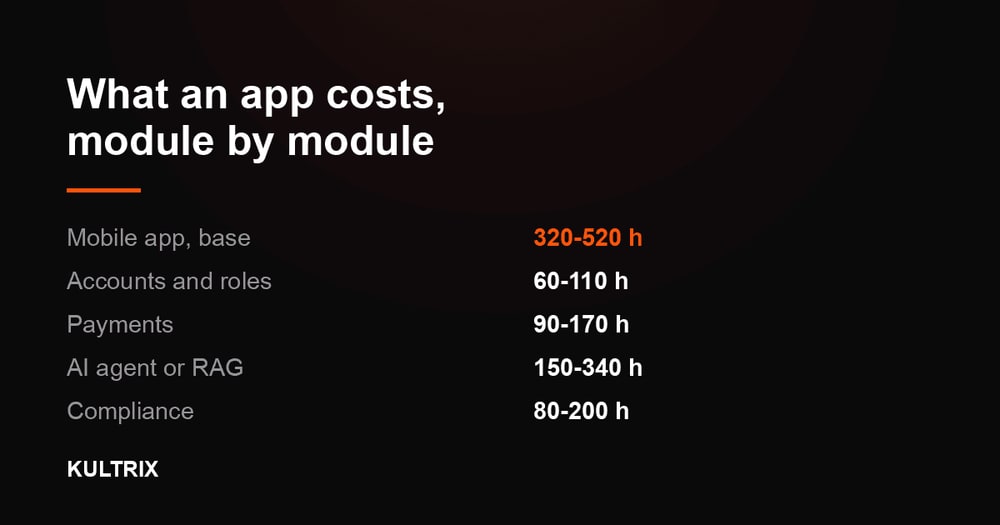
A UX audit and design-only engagement ranges from $15,000-$35,000. A full redesign including implementation - accounts, payments, a content layer and an admin panel rebuilt on top of the new design - is 800-1,410 hours, or $24,000-$43,000 at our rate card. Larger apps with chat, real-time and offline sync are 1,240-2,310 hours, or $38,000-$70,000. We price the audit separately so you can validate the findings before committing to implementation. Price your own scope at kultrix.com/cost-calculator.