OUR SERVICES
IoT Development from Firmware to Cloud Dashboard
We build end-to-end IoT systems that collect, transmit, process, and visualise data from physical devices at scale.


OUR SERVICES
We build end-to-end IoT systems that collect, transmit, process, and visualise data from physical devices at scale.

Tell us what you are building - what exists today, what it has to do and when it has to be live. We come back with the questions we need answered and a scoped estimate instead of a range.
EXPERTISE
OUR APPROACH
Choose the cooperation format that best fits your business goals and development velocity.
Fast launch to test your idea and gather user feedback with minimal investment.
What's included
Timeline Typically 9-16 weeks
Complete cycle from initial strategy and design to final launch.
What's included
Timeline Typically 20-40 weeks
Scale your team with expert developers to accelerate development.
What's included
Timeline Flexible / Long-term
OUR PROCESS
We specialize in creating user-centered & innovative solutions. Delivering seamless digital experiences.
EXPERT INSIGHTS
Edge computing processes data where it is generated - cloud processing centralizes power at the cost of latency and connectivity dependency.
Sub-millisecond latency
Critical decisions (safety shutoffs, robotics) cannot wait for a cloud round-trip.
Offline resilience
Devices continue operating during network outages - essential for industrial IoT.
Bandwidth efficiency
Pre-process and aggregate sensor data locally - send only anomalies to cloud.
Data sovereignty
Sensitive sensor data never leaves the facility - simplifies HIPAA and GDPR compliance.
Unlimited compute on demand
Scale ML inference and analytics without provisioning edge hardware.
Centralized management
Single pane of glass for firmware OTA updates and fleet monitoring.
Advanced analytics
Run complex ML pipelines (SageMaker, Azure ML) on aggregated data.
Lower upfront cost
No edge hardware investment - pay-as-you-go ingestion and storage.
EXPERT GUIDANCE
Protocol Overhead
Minimal - 2-byte header; ideal for constrained devices (ESP32, STM32).
Connection Model
Persistent TCP connection - broker pushes messages instantly.
Message Reliability
QoS levels 0/1/2 guarantee at-most / at-least / exactly-once delivery.
Fan-Out
One publish to a topic reaches thousands of subscribers instantly.
Infrastructure
Broker required - AWS IoT Core, EMQX, or self-hosted Mosquitto.
Best For
Sensor telemetry, real-time command & control, low-bandwidth devices.
Protocol Overhead
Heavy HTTP headers - impractical for low-power microcontrollers.
Connection Model
Request/response polling - devices must check for updates.
Message Reliability
No built-in retry - must implement at application layer.
Fan-Out
Requires separate request to each subscriber - N requests for N devices.
Infrastructure
Standard HTTP server - simpler infrastructure for REST teams.
Best For
Device provisioning, firmware downloads, infrequent configuration updates.
Feature
MQTT (Pub/Sub)
REST / HTTP
DELIVERABLES
System Architecture
A full-stack IoT architecture document covering device, connectivity, cloud, and data layers with latency and cost models.
Firmware / Edge Code
Production-ready firmware in C/C++ or MicroPython for your microcontroller, including OTA update capability.
Connectivity Layer
Secure MQTT or HTTPS telemetry pipeline with TLS, device certificates, and broker configuration on AWS IoT or Azure IoT Hub.
Cloud Data Backend
A time-series ingest pipeline with InfluxDB or TimescaleDB, data retention policies, and downsampling for long-term storage.
Fleet Management UI
A web dashboard for monitoring device health, triggering OTA updates, setting alert thresholds, and visualising sensor data.
Alerting & Runbook
Configurable anomaly alerts via email, SMS, or PagerDuty, plus an operational runbook for your facilities or ops team.
INDUSTRIES
We build powerful digital experiences across various sectors, ensuring your product meets unique market demands.
Data-driven commerce solutions that improve journeys, boost sales, and optimize operations.
Data-driven commerce solutions that improve journeys, increase sales, and optimize operations.
Reliable medical platforms that protect patient data, simplify workflows, and support clinical accuracy.
Product-driven platforms that enhance workflows, automate processes, and scale with your business.
CASE STUDIES
START YOUR PROJECT
Expert developers ready to deliver high-quality digital products.
INSIGHTS

Thirteen Ukrainian app development companies, each named with a link to its own site and described only from what that site claims. Alphabetical, no scores, no prices. Kultrix is one of the thirteen.
2026-08-26

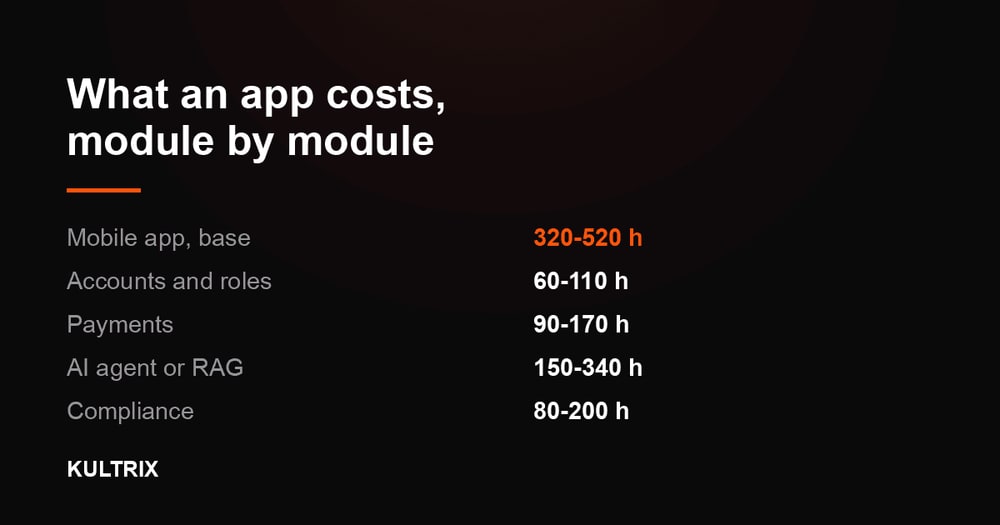
What an app costs and how long it takes, in hours: a mobile base is 320-520 hours, all fifteen modules from 40-90 to 150-340 hours, and a plan built on 18 focused hours a week.
2026-08-24

How to choose a software development agency: what to ask, what to ask them to show, and how to compare two proposals by stripping the rates out and reading the hours.
2026-08-24
FAQ
We build industrial monitoring systems (vibration, temperature, pressure), smart building solutions (occupancy, HVAC, energy), consumer connected products, agricultural sensor networks, cold-chain logistics trackers, and custom device integrations for existing hardware. Every project starts with a connectivity and power constraints review.
Yes. Our embedded engineers write firmware in C, C++, and MicroPython for ESP32, STM32, Raspberry Pi, and Arduino-class hardware. We implement low-power sleep cycles, sensor drivers, and OTA update systems. We also partner with hardware design firms when a custom PCB is part of the scope.
We work with MQTT, HTTPS, CoAP, Modbus, BACnet, AMQP, and LoRaWAN depending on the use case. For cellular deployments we use SIM7600 and Quectel modules with NB-IoT or LTE-M. Protocol selection is driven by message frequency, payload size, power budget, and network availability at the deployment site.
Security is layered at every level: TLS 1.3 for transport, X.509 device certificates provisioned in secure element storage, least-privilege IAM policies on the cloud broker, encrypted firmware images for OTA, and network segmentation recommendations for on-premise deployments. We conduct a threat model review at the start of every engagement.
We implement local buffering on the device so data is persisted to flash when connectivity drops and flushed in batches on reconnection. For critical alerts we use SMS or LoRaWAN as a secondary channel. The cloud backend handles out-of-order message arrival and duplicate detection transparently.
Yes. We integrate IoT data streams with SAP, Oracle, Ignition SCADA, and building management systems via OPC-UA, REST APIs, or database connectors. We normalise units and timestamps before writing to any downstream system to prevent data quality issues.
We primarily use AWS IoT Core, Azure IoT Hub, and Google Cloud IoT (Pub/Sub). For on-premise or private cloud deployments we use Eclipse Mosquitto or HiveMQ. Database choices depend on query patterns: InfluxDB for pure time-series, TimescaleDB for relational time-series, and Postgres for configuration and metadata.
We design for horizontal scale from the start: managed MQTT brokers with auto-scaling groups, partitioned Kinesis or Kafka streams for high-throughput ingestion, and pre-aggregated rollups so dashboards do not hit raw data tables. We load-test the architecture against your projected device count before production launch.
Yes. We deploy quantised ML models (TensorFlow Lite, ONNX) onto microcontrollers and edge compute modules (NVIDIA Jetson, Coral TPU) for on-device inference. Common use cases include anomaly detection, predictive maintenance, and computer vision quality control - all running locally without cloud round-trips.
A cloud dashboard for an existing hardware device takes 6-10 weeks. A full-stack system including firmware, connectivity, cloud backend, and dashboard for a new device takes 4-8 months. Hardware procurement and regulatory certification (FCC, CE) are external dependencies that can add 2-4 months.
A cloud integration for existing hardware starts at $20,000-$45,000. For a full end-to-end system the software half - both clients on one backend with the whole module list switched on - is 2,200-4,300 hours, or $67,000-$131,000. Firmware, hardware and regulatory certification are quoted separately, because they are not software hours. Ongoing cloud spend is billed by your cloud provider and scales with message volume and data retention. Price the software half at kultrix.com/cost-calculator.
Our fleet management system maintains a heartbeat timestamp for every device and raises a configurable alert when a device misses its expected check-in. Alerts can route to email, Slack, PagerDuty, or a custom webhook. The dashboard shows last-seen timestamps and accumulated offline duration for every device in your fleet.