OUR SERVICES
Tailwind CSS Agency - Rapid UI Development
We build production UIs with Tailwind CSS that are faster to develop, easier to maintain, and simpler to hand off than custom CSS.


OUR SERVICES
We build production UIs with Tailwind CSS that are faster to develop, easier to maintain, and simpler to hand off than custom CSS.

Tell us what you are building - what exists today, what it has to do and when it has to be live. We come back with the questions we need answered and a scoped estimate instead of a range.
EXPERTISE
OUR APPROACH
Choose the cooperation format that best fits your business goals and development velocity.
Fast launch to test your idea and gather user feedback with minimal investment.
What's included
Timeline Typically 9-16 weeks
Complete cycle from initial strategy and design to final launch.
What's included
Timeline Typically 20-40 weeks
Scale your team with expert developers to accelerate development.
What's included
Timeline Flexible / Long-term
OUR PROCESS
We specialize in creating user-centered & innovative solutions. Delivering seamless digital experiences.
EXPERT INSIGHTS
The Tailwind utility-first approach eliminates context switching and dead code, producing smaller production stylesheets.
No naming decisions
Utilities are pre-named - no time lost on class naming conventions.
Design system built in
Spacing, colour, and typography scales are consistent by default.
Zero dead CSS in production
PurgeCSS removes every unused class - minimal stylesheet payload.
Fast iteration
Style in markup - no file switching to change appearance.
Scoped by default
Class names are locally scoped - no collision risk.
Standard CSS syntax
No new utility names to learn - write CSS as you always have.
Full CSS power
Keyframes, custom properties, and complex selectors all supported.
Semantic class names
Class names describe intent - easier to read in DevTools.
EXPERT GUIDANCE
Developer Speed
Fast - utilities composable inline without leaving JSX.
Bundle Size
Tiny production CSS - only used utilities shipped.
Design Consistency
Enforced by the scale - impossible to use off-scale values.
Readability
Long class strings in JSX can be verbose.
Customisation
Extend via tailwind.config - theme tokens apply everywhere.
Best For
Design-system-driven product teams, rapid prototyping.
Developer Speed
Slower - requires switching between component and .module.css.
Bundle Size
Grows with each component; requires manual audit.
Design Consistency
Requires a manual design token system to stay consistent.
Readability
Semantic names in JSX; actual styles in separate file.
Customisation
Full CSS flexibility - any selector or at-rule.
Best For
Complex animations, per-component isolation, legacy teams.
Feature
Tailwind CSS
CSS Modules
DELIVERABLES
Tailwind Config
Custom tailwind.config.js with design tokens - colors, spacing, typography, and breakpoints.
Component System
shadcn/ui-based component library with CVA variants and accessible Radix primitives.
Responsive Layouts
Mobile-first responsive layouts across all breakpoints with consistent spacing.
Dark Mode
CSS variable-based dark mode with class or system preference detection.
Storybook Docs
Storybook stories for all UI components with variant controls and accessibility checks.
CSS Audit
PurgeCSS verification and final bundle analysis confirming minimal CSS output.
INDUSTRIES
We build powerful digital experiences across various sectors, ensuring your product meets unique market demands.
Data-driven commerce solutions that improve journeys, boost sales, and optimize operations.
Data-driven commerce solutions that improve journeys, increase sales, and optimize operations.
Reliable medical platforms that protect patient data, simplify workflows, and support clinical accuracy.
Product-driven platforms that enhance workflows, automate processes, and scale with your business.
CASE STUDIES
START YOUR PROJECT
Expert developers ready to deliver high-quality digital products.
INSIGHTS

Thirteen Ukrainian app development companies, each named with a link to its own site and described only from what that site claims. Alphabetical, no scores, no prices. Kultrix is one of the thirteen.
2026-08-26

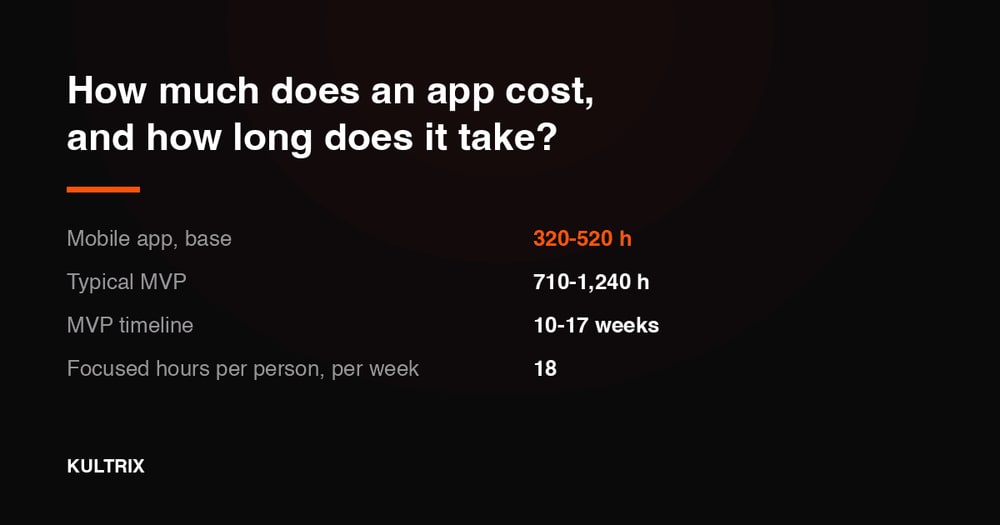
What an app costs and how long it takes, in hours: a mobile base is 320-520 hours, all fifteen modules from 40-90 to 150-340 hours, and a plan built on 18 focused hours a week.
2026-08-24

How to choose a software development agency: what to ask, what to ask them to show, and how to compare two proposals by stripping the rates out and reading the hours.
2026-08-24
FAQ
Tailwind eliminates the naming problem - no inventing class names, no specificity wars, no dead CSS accumulating over time. Utilities applied directly in HTML make layout and spacing changes instantaneous. Teams consistently report 30-50% faster UI development after adopting Tailwind.
No. Tailwind scans your source files and includes only the classes you use. A production Tailwind build is typically 5-20KB gzipped. The raw Tailwind CSS file is large, but the build output is smaller than most hand-crafted CSS files.
shadcn/ui is a collection of accessible, unstyled React components built on Radix UI primitives, styled with Tailwind CSS. Components are copied into your project (not installed as a dependency), giving full ownership and customization. Kultrix uses shadcn/ui as the baseline for Tailwind-based design systems.
Class Variance Authority (CVA) is a library for managing Tailwind class variants programmatically - defining a component's style variations (size, intent, state) in a type-safe way. It replaces ad-hoc template literal string concatenation and makes component APIs self-documenting.
We extend the Tailwind config with your brand colors, typography scales, spacing values, and breakpoints. CSS custom properties (variables) store the token values, enabling runtime theming and dark mode switching without rebuilding. This creates a single source of truth between Figma and code.
We use the class-based dark mode strategy - toggling a dark class on the root element via JavaScript. CSS variables for colors update based on the dark class, and Tailwind's dark: variant classes override light-mode styles. System preference detection with prefers-color-scheme is the default.
It is possible but creates conflicts - both systems generate CSS and their specificity can clash. We recommend either Tailwind with Radix/shadcn/ui, or a component library like MUI with its own styling system. Mixing both usually leads to CSS maintenance problems.
We use Prettier with the official prettier-plugin-tailwindcss to sort classes consistently, enforce a maximum class count in components via ESLint rules, extract repeated patterns into component abstractions, and use CVA for variant management rather than conditional string concatenation.
Only when scoping is necessary - Tailwind's utility-first approach usually makes CSS Modules redundant. For complex custom components that cannot be expressed purely in utilities (complex animations, pseudo-element tricks), we add a small scoped stylesheet alongside the Tailwind classes.
Tailwind's mobile-first breakpoints (sm:, md:, lg:, xl:, 2xl:) are applied directly in HTML. We design and build mobile-first, progressively enhancing layouts at each breakpoint. Custom breakpoints are added to the Tailwind config to match the design system.
Yes. Kultrix performs CSS migrations to Tailwind - removing Bootstrap or styled-components incrementally, rebuilding components in Tailwind, and validating visual parity at each step. We prioritize high-traffic pages first to deliver immediate performance gains.
Tailwind speeds up frontend work because the design decisions live in one config instead of in a stylesheet nobody owns. A design system of twenty to thirty core components is a fixed-scope piece we date after the design review. A full marketing site or web app frontend in Tailwind takes 4-10 weeks depending on complexity. You see working UI in the first sprint.