OUR SERVICES
Firebase Development & Architecture
Firebase lets small teams move fast without managing infrastructure. Used correctly, it scales to millions of users; used incorrectly, it produces runaway costs and security nightmares.


OUR SERVICES
Firebase lets small teams move fast without managing infrastructure. Used correctly, it scales to millions of users; used incorrectly, it produces runaway costs and security nightmares.

Tell us what you are building - what exists today, what it has to do and when it has to be live. We come back with the questions we need answered and a scoped estimate instead of a range.
EXPERTISE
OUR APPROACH
Choose the cooperation format that best fits your business goals and development velocity.
Fast launch to test your idea and gather user feedback with minimal investment.
What's included
Timeline Typically 9-16 weeks
Complete cycle from initial strategy and design to final launch.
What's included
Timeline Typically 20-40 weeks
Scale your team with expert developers to accelerate development.
What's included
Timeline Flexible / Long-term
OUR PROCESS
We specialize in creating user-centered & innovative solutions. Delivering seamless digital experiences.
EXPERT INSIGHTS
Firebase eliminates backend boilerplate and ships MVPs faster. Custom backends give you full control as complexity grows.
Realtime sync built-in
Firestore and Realtime Database push updates to clients instantly - no WebSocket code needed.
Auth in minutes
Email, Google, Apple, and phone auth with SDKs for every platform.
Zero backend to manage
Cloud Functions handle server logic - no servers, scaling, or ops.
Tight frontend integration
Official React, Flutter, and Swift SDKs make integration trivial.
Full data model control
Design your schema, indexes, and queries exactly as needed.
Predictable costs
Fixed server costs - no read/write/storage pricing surprises.
Complex business logic
Multi-step transactions, domain events, and workflow engines.
Vendor independence
Run on any cloud or on-premise - no Google dependency.
EXPERT GUIDANCE
Data Model
Collections and documents - hierarchical, rich querying.
Querying
Compound queries with multiple field filters and sorting.
Offline Support
Full offline persistence with local cache - web and mobile.
Pricing
Per document read/write/delete - can be expensive at scale.
Scalability
Multi-region, horizontal auto-sharding - petabyte-scale.
Best For
Most apps - e-commerce, social, SaaS dashboards.
Data Model
Single JSON tree - simpler but no complex queries.
Querying
Limited - order by one field, filter by one condition.
Offline Support
Offline support - simpler disk persistence.
Pricing
Per GB stored and per GB transferred - cheaper for chat-style apps.
Scalability
Single region, limited to ~200,000 concurrent connections.
Best For
Real-time chat, presence, and extremely low-latency counters.
Feature
Firestore
Realtime Database
DELIVERABLES
Firestore Data Model
Collection and subcollection structure designed around your query patterns, with index configuration included.
Security Rules
Firestore and Storage security rules that enforce authentication and ownership at the database layer - tested with the emulator suite.
Auth Implementation
Firebase Authentication with email, social OAuth, and custom claims for role-based access control.
Cloud Functions
Server-side logic deployed as Cloud Functions - triggers, scheduled jobs, and HTTP endpoints with proper error handling.
Real-Time Features
Live data listeners implemented efficiently to minimise reads and prevent runaway Firestore costs.
Cost Controls
Budget alerts, read/write optimisation review, and a usage dashboard so your Firebase bill never surprises you.
INDUSTRIES
We build powerful digital experiences across various sectors, ensuring your product meets unique market demands.
Data-driven commerce solutions that improve journeys, boost sales, and optimize operations.
Data-driven commerce solutions that improve journeys, increase sales, and optimize operations.
Reliable medical platforms that protect patient data, simplify workflows, and support clinical accuracy.
Product-driven platforms that enhance workflows, automate processes, and scale with your business.
CASE STUDIES
START YOUR PROJECT
Expert developers ready to deliver high-quality digital products.
INSIGHTS

Thirteen Ukrainian app development companies, each named with a link to its own site and described only from what that site claims. Alphabetical, no scores, no prices. Kultrix is one of the thirteen.
2026-08-26

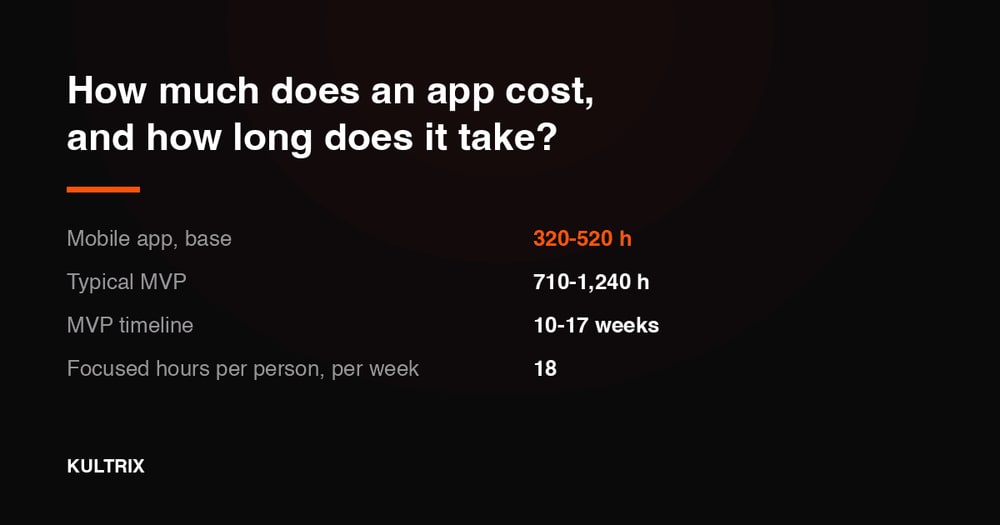
What an app costs and how long it takes, in hours: a mobile base is 320-520 hours, all fifteen modules from 40-90 to 150-340 hours, and a plan built on 18 focused hours a week.
2026-08-24

How to choose a software development agency: what to ask, what to ask them to show, and how to compare two proposals by stripping the rates out and reading the hours.
2026-08-24
FAQ
Yes, Firebase is production-proven at massive scale - apps like Duolingo and The New York Times use it. It is best suited for applications with real-time requirements, rapid development timelines, or small engineering teams that cannot afford to manage backend infrastructure. It is a less natural fit for complex relational data, analytics-heavy workloads, or applications with strict data residency requirements.
Firestore is the current recommended Firebase database for new projects. It provides a richer query model, better offline support, and scales horizontally. Realtime Database is the original Firebase database - it is simpler but has fewer querying capabilities and manual scaling considerations. For new projects we always choose Firestore unless you have a specific use case like very high-frequency small writes (e.g. live cursor positions) where Realtime Database has an edge.
Security rules are the most critical part of a Firebase application. We write rules that verify authentication, validate data shape, and enforce document ownership - for example, ensuring a user can only read their own records. We test rules exhaustively using the Firebase Emulator Suite before deploying. We also disable all open read/write access from the start and enable services explicitly.
Firestore charges per document read, write, and delete. Poorly designed queries that read entire collections, inefficient listeners that trigger on every change, and missing pagination can cause read counts to explode. We model your data to minimise reads, use query cursors for pagination, aggregate data with Cloud Functions instead of client-side counting, and set up budget alerts that send notifications and can disable billing to prevent runaway spend.
Firestore data modelling is the opposite of relational normalisation - you model for reads, not to eliminate redundancy. We define your top-level collections around your primary access patterns, use subcollections for hierarchical one-to-many relationships, and duplicate fields where it avoids an extra query. We document every denormalisation decision and add Cloud Functions to keep duplicated data consistent.
Yes, though it requires a data model redesign rather than a direct export. We analyse your relational schema, identify the application query patterns, and design a Firestore structure optimised for those reads. We then write a migration script that transforms and imports the data, verify integrity, and run the old and new systems in parallel during a cutover window.
Cloud Functions are the escape hatch for logic that does not belong on the client: sending emails, processing payments, running background jobs, integrating with third-party APIs, and enforcing business rules that security rules cannot express. We write typed Cloud Functions in TypeScript, deploy them behind HTTPS endpoints or Firestore triggers, and monitor them with Cloud Logging and Error Reporting.
Yes. Firestore has built-in offline persistence for web and mobile clients. Reads are served from a local cache when offline, writes are queued and flushed automatically when connectivity is restored. We design the data model and UI states to handle offline gracefully - including conflict resolution when the same document is modified offline on multiple devices.
Yes. Firebase scales automatically - you do not provision servers or worry about connection limits in the traditional sense. Firestore can handle millions of concurrent users with sub-second latency. The limiting factors are cost (reads and writes add up at scale) and Firestore query limitations (no full-text search, limited compound queries). We plan for scale from the architecture stage so these limitations do not surprise you later.
Yes. We implement email/password, Google, Apple, and other OAuth providers through Firebase Authentication. We also set up custom claims for role-based access (admin, member, viewer) that propagate to Firestore security rules. For enterprise needs we configure SAML or OIDC integration with your identity provider.
We use the Firebase Local Emulator Suite to run Firestore, Authentication, Cloud Functions, and Storage locally in CI. Security rule tests run against the emulator with the @firebase/rules-unit-testing library. Cloud Functions are tested with Jest. This means the entire backend can be tested without touching production data or incurring Firestore read costs.
Yes. We perform a Firebase audit covering security rules, data model efficiency, cost analysis, and Cloud Function error rates. The audit typically reveals the highest-cost and highest-risk issues within a few days. We then prioritise fixes - security holes first, cost optimisations second - and work through the remediation iteratively without a full rewrite.