OUR SERVICES
Docker & Kubernetes Engineering
Containers solve the "it works on my machine" problem. Kubernetes solves the problem of running hundreds of containers reliably in production.


OUR SERVICES
Containers solve the "it works on my machine" problem. Kubernetes solves the problem of running hundreds of containers reliably in production.

Tell us what you are building - what exists today, what it has to do and when it has to be live. We come back with the questions we need answered and a scoped estimate instead of a range.
EXPERTISE
OUR APPROACH
Choose the cooperation format that best fits your business goals and development velocity.
Fast launch to test your idea and gather user feedback with minimal investment.
What's included
Timeline Typically 9-16 weeks
Complete cycle from initial strategy and design to final launch.
What's included
Timeline Typically 20-40 weeks
Scale your team with expert developers to accelerate development.
What's included
Timeline Flexible / Long-term
OUR PROCESS
We specialize in creating user-centered & innovative solutions. Delivering seamless digital experiences.
EXPERT INSIGHTS
Docker Compose runs containers on one machine. Kubernetes orchestrates them across a cluster with self-healing, auto-scaling, and rolling deploys.
Self-healing workloads
Failed pods are automatically replaced - zero intervention for transient failures.
Horizontal auto-scaling
HPA scales replicas based on CPU, memory, or custom metrics like queue depth.
Rolling deployments
Deploy new versions with zero downtime - instant rollback on failure.
Multi-node resource efficiency
Bin-packs pods across nodes - maximizes hardware utilization.
Trivial to learn
One YAML file - define services, networks, and volumes in minutes.
Perfect for development
Spin up databases, queues, and APIs locally with docker compose up.
No cluster overhead
No control plane, etcd, or CNI networking complexity.
Sufficient for small scale
A single well-spec'd VPS handles most startup workloads.
EXPERT GUIDANCE
Control Plane
Managed and SLA-backed - no etcd to operate. EKS extended support: $0.60 per cluster-hour at vendor price.
Upgrades
One-click version upgrades with managed node group rolling updates.
Networking
VPC-native CNI (AWS VPC CNI, GKE Dataplane V2) - tight cloud integration.
Cost
Vendor list price: $0.10 per cluster-hour. GKE credits back $74.40 per month on the free tier.
IAM Integration
IRSA (AWS) or Workload Identity (GCP) - pods assume cloud roles natively.
Best For
Production workloads, compliance-sensitive apps, teams without K8s ops expertise.
Control Plane
You own etcd backups, upgrades, and HA configuration.
Upgrades
Manual kubeadm upgrade - risky without robust backup/restore.
Networking
Flannel, Calico, or Cilium - fully configurable but self-managed.
Cost
No cluster fee - you pay only for the VMs you already run.
IAM Integration
Manual secret management or external-secrets operator required.
Best For
Edge computing, on-premise deployments, cost-sensitive setups.
Feature
Managed K8s (EKS / GKE)
Self-Hosted (kubeadm / k3s)
Figures above are indicative ranges, not a quote. Anything marked as a vendor list price is that vendor's own published price, not ours. Our own work is billed at $35/hour for design and development, $20/hour for QA and $20/hour for project management, a blended $30.5/hour, the same numbers behind the cost calculator. What a project costs on top of that depends on scope, integrations and compliance.
DELIVERABLES
Docker Image Strategy
Multi-stage Dockerfiles with minimal base images, layer caching, and Trivy vulnerability scanning in CI.
Kubernetes Manifests
Production-grade Deployments, Services, Ingress, ConfigMaps, and HPA resources following namespace isolation.
Helm Chart Library
Reusable Helm charts parameterised for each environment - deploy a new service with a single values override.
GitOps with ArgoCD
All cluster state managed through git pull requests with ArgoCD enforcing desired state continuously.
Service Mesh
Istio or Linkerd configured for mTLS, traffic shaping, circuit breaking, and distributed tracing.
Cluster Observability
Prometheus metrics, Grafana dashboards, and Loki log aggregation with pre-built Kubernetes alerts.
INDUSTRIES
We build powerful digital experiences across various sectors, ensuring your product meets unique market demands.
Data-driven commerce solutions that improve journeys, boost sales, and optimize operations.
Data-driven commerce solutions that improve journeys, increase sales, and optimize operations.
Reliable medical platforms that protect patient data, simplify workflows, and support clinical accuracy.
Product-driven platforms that enhance workflows, automate processes, and scale with your business.
CASE STUDIES
START YOUR PROJECT
Expert developers ready to deliver high-quality digital products.
INSIGHTS

Thirteen Ukrainian app development companies, each named with a link to its own site and described only from what that site claims. Alphabetical, no scores, no prices. Kultrix is one of the thirteen.
2026-08-26

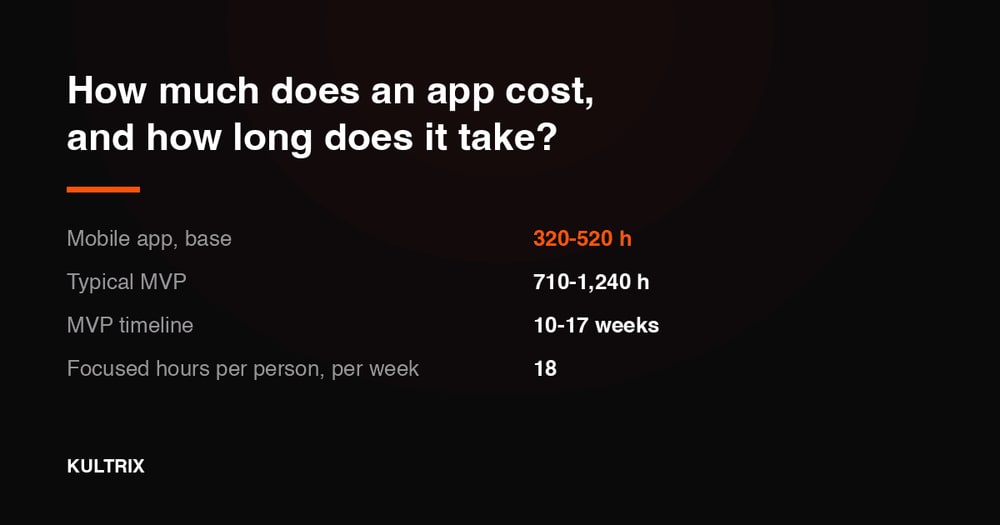
What an app costs and how long it takes, in hours: a mobile base is 320-520 hours, all fifteen modules from 40-90 to 150-340 hours, and a plan built on 18 focused hours a week.
2026-08-24

How to choose a software development agency: what to ask, what to ask them to show, and how to compare two proposals by stripping the rates out and reading the hours.
2026-08-24
FAQ
Docker Compose is great for local development and simple single-server deployments. Kubernetes makes sense when you need automatic failover, horizontal scaling, rolling deployments, or are running more than a handful of services. A useful threshold: if you have more than 5 services or more than 3 engineers deploying to production, Kubernetes pays for its complexity. Below that, a managed platform like Railway or Render plus Docker often gives you 80% of the benefit with 20% of the ops work.
We work with EKS (AWS), GKE (Google Cloud), AKS (Azure), and self-managed clusters on bare metal or virtual machines. For most startups we recommend EKS or GKE because the managed control plane eliminates a significant operational burden. We have also worked with k3s for edge and IoT deployments where a lightweight distribution is required.
We use multi-stage builds to keep the final image as small as possible - often under 50MB - which reduces both attack surface and pull time. We run processes as a non-root user, avoid copying unnecessary files with .dockerignore, pin base image versions by digest, and scan images with Trivy in CI. Images that fail security scans block the pipeline.
We never store secrets as plain-text Kubernetes Secrets (they are only base64-encoded, not encrypted). Instead we use the Secrets Store CSI Driver to mount secrets from AWS Secrets Manager, HashiCorp Vault, or GCP Secret Manager directly into pods. Secrets are rotated automatically and pods receive updated values without a restart when possible.
We configure Horizontal Pod Autoscaler (HPA) based on CPU, memory, or custom metrics via KEDA - for example, queue depth from SQS or Kafka. We also set up Cluster Autoscaler to add and remove nodes automatically, and Vertical Pod Autoscaler to right-size resource requests over time. The result is a cluster that handles traffic spikes without over-provisioning for off-peak periods.
GitOps means using git as the single source of truth for your cluster state. Every change - scaling a deployment, updating a config, rotating a secret reference - goes through a pull request. ArgoCD continuously reconciles the cluster against the desired state in git and alerts on drift. The result is a complete audit trail, peer review of every infrastructure change, and automatic recovery if someone accidentally modifies the cluster directly.
Kubernetes Deployments perform rolling updates by default, replacing pods gradually while maintaining availability. We configure maxUnavailable and maxSurge to control the rollout speed. Rollback is a single command (kubectl rollout undo) or, with GitOps, a git revert - the previous image is redeployed automatically. We also integrate deployment health checks that pause a rollout if the new pods are crashing.
Yes, when the complexity is justified. A service mesh like Istio or Linkerd provides mutual TLS between services, fine-grained traffic policies (canary routing, circuit breaking), and detailed telemetry without modifying application code. We typically introduce a service mesh when you have 10+ services with service-to-service communication and need mTLS for compliance or traffic management for canary releases.
We deploy the kube-prometheus-stack (Prometheus Operator, Grafana, AlertManager) for cluster and workload metrics, and Loki for log aggregation. We set up pre-built Kubernetes dashboards covering node health, pod resource usage, HPA status, and PersistentVolume capacity. Alerts route to Slack and PagerDuty with runbooks attached so the on-call engineer knows what to do.
Stateful workloads like databases use StatefulSets with PersistentVolumeClaims backed by cloud-native storage (EBS, GCS PD). However, for most production use cases we recommend running databases outside the cluster - on RDS, Cloud SQL, or managed MongoDB - where backup, failover, and patching are handled by the cloud provider. Running stateful databases in Kubernetes adds operational complexity that is rarely worth it.
Yes. We use Kompose to get a baseline translation, then refine the manifests to follow production best practices - adding resource limits, health probes, horizontal scaling, and proper secret management. We do not skip the refinement step; raw Kompose output is rarely production-ready. The migration is done service by service with parallel environments so there is no big-bang cutover.
Cluster maintenance includes Kubernetes version upgrades (we target no more than 2 minor versions behind), node image patching, certificate rotation, etcd backups, and periodic review of resource limits and requests. With EKS or GKE, the control plane is managed automatically; node groups still need planned upgrades. We handle this as part of our managed infrastructure retainer or document the process for your team to own.