OUR SERVICES
Real-Time App Development Built for Low Latency
We architect and build real-time applications where milliseconds matter, collaborative editors, live dashboards, multiplayer games, trading interfaces, and event-driven platforms.


OUR SERVICES
We architect and build real-time applications where milliseconds matter, collaborative editors, live dashboards, multiplayer games, trading interfaces, and event-driven platforms.

Tell us what you are building - what exists today, what it has to do and when it has to be live. We come back with the questions we need answered and a scoped estimate instead of a range.
EXPERTISE
OUR APPROACH
Choose the cooperation format that best fits your business goals and development velocity.
Fast launch to test your idea and gather user feedback with minimal investment.
What's included
Timeline Typically 9-16 weeks
Complete cycle from initial strategy and design to final launch.
What's included
Timeline Typically 20-40 weeks
Scale your team with expert developers to accelerate development.
What's included
Timeline Flexible / Long-term
OUR PROCESS
We specialize in creating user-centered & innovative solutions. Delivering seamless digital experiences.
EXPERT INSIGHTS
WebSockets enable true bidirectional communication. SSE is simpler but only flows one way - server to client.
Full-duplex communication
Client and server send messages simultaneously - required for chat, gaming, and collaborative editing.
Low latency
Persistent TCP connection eliminates HTTP handshake overhead on every message.
Binary protocol support
Send typed arrays and binary blobs - critical for real-time data streams and WebRTC signaling.
Broad ecosystem
Socket.IO, Ably, Pusher, and native ws libraries cover every language and scale requirement.
Works over standard HTTP/2
No WebSocket upgrade - passes through corporate proxies and CDNs.
Automatic reconnection
Browser handles reconnect and last-event-id replay natively.
Simpler server implementation
A plain HTTP endpoint with chunked transfer - no special server needed.
Native browser EventSource API
No library required - works in all modern browsers out of the box.
EXPERT GUIDANCE
Operational Overhead
Zero - no servers to manage, auto-scales to millions of connections.
Global Latency
Points of presence in 6+ regions - sub-50ms worldwide.
Message History
Built-in replay and persistence - reconnecting clients catch up automatically.
Cost at Scale
Per-message and per-connection pricing - expensive above 10M messages/day.
Presence & Channels
Built-in presence API - who is online, what channel they are in.
Best For
Startups, MVPs, apps needing global reach fast.
Operational Overhead
Must provision, cluster, and monitor Redis or Socket.IO nodes.
Global Latency
Latency tied to server geography - users on other continents suffer.
Message History
Custom implementation required in Redis Streams or a database.
Cost at Scale
Fixed server cost - dramatically cheaper at high volume.
Presence & Channels
Must implement presence tracking manually in Redis sets.
Best For
High-volume products where server cost outweighs engineering cost.
Feature
Managed (Ably / Pusher)
Self-Hosted (Redis Pub/Sub / Socket.IO)
DELIVERABLES
Real-Time Architecture
A documented system design covering connection management, event routing, conflict resolution, and failover strategy.
WebSocket Backend
A horizontally scalable WebSocket server with Redis pub-sub for cross-instance message fan-out and sticky session routing.
Presence & Awareness
Live user presence indicators showing who is online, where they are in the UI, and what they are working on.
Conflict Resolution
CRDT or OT-based merge logic that keeps shared state consistent without locking, even under concurrent edits.
Live UI Components
Optimistic-update React components with graceful degradation to polling when WebSocket connections drop.
Load & Chaos Tests
Load tests simulating peak concurrent users and chaos tests validating reconnection, data consistency, and graceful degradation.
INDUSTRIES
We build powerful digital experiences across various sectors, ensuring your product meets unique market demands.
Data-driven commerce solutions that improve journeys, boost sales, and optimize operations.
Data-driven commerce solutions that improve journeys, increase sales, and optimize operations.
Reliable medical platforms that protect patient data, simplify workflows, and support clinical accuracy.
Product-driven platforms that enhance workflows, automate processes, and scale with your business.
CASE STUDIES
START YOUR PROJECT
Expert developers ready to deliver high-quality digital products.
INSIGHTS

Thirteen Ukrainian app development companies, each named with a link to its own site and described only from what that site claims. Alphabetical, no scores, no prices. Kultrix is one of the thirteen.
2026-08-26

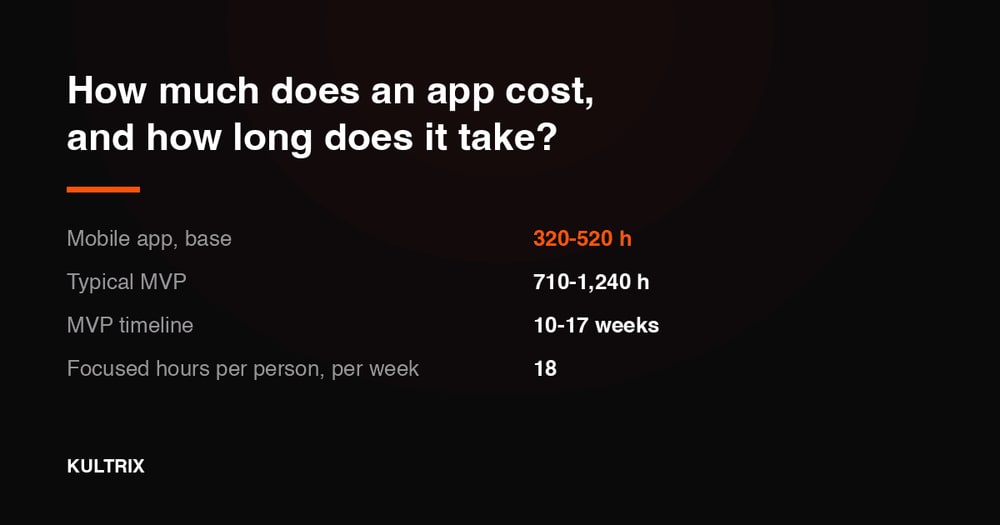
What an app costs and how long it takes, in hours: a mobile base is 320-520 hours, all fifteen modules from 40-90 to 150-340 hours, and a plan built on 18 focused hours a week.
2026-08-24

How to choose a software development agency: what to ask, what to ask them to show, and how to compare two proposals by stripping the rates out and reading the hours.
2026-08-24
FAQ
Any application where state changes made by one user must appear to other users within hundreds of milliseconds - without a page refresh. This includes collaborative editing tools, live dashboards, chat systems, multiplayer games, live auction platforms, co-browsing tools, and financial trading interfaces.
WebSockets are best for bidirectional, low-latency communication where the client also sends events (chat, collaboration, games). Server-Sent Events (SSE) are simpler for one-way server-to-client streams like live feeds or dashboards. Polling is a fallback for environments where WebSockets are blocked. We choose based on your latency requirements and infrastructure constraints.
We implement CRDTs (Conflict-free Replicated Data Types) for document collaboration and operational transformation (OT) for text editors. These algorithms merge concurrent changes mathematically, ensuring all clients converge to the same state without manual conflict resolution or data loss. For simpler cases, optimistic locking with user-visible conflict warnings is sufficient.
WebSockets are stateful, which complicates horizontal scaling. We solve this with Redis pub-sub (or Valkey) as the inter-instance message bus: any server can receive a client message and broadcast it to all relevant connections on any other server instance. We also configure sticky sessions at the load balancer for connection affinity during reconnects.
We implement exponential backoff reconnection with jitter on the client, server-side missed-event queuing so clients catch up on reconnect, and operation sequence numbers to detect and fill gaps. Users see a graceful reconnecting indicator rather than stale or lost data.
Our architecture is designed for tens of thousands of concurrent WebSocket connections per server instance using Node.js with libuv. Beyond that, horizontal scaling with Redis pub-sub supports hundreds of thousands of simultaneous connections. We run load tests against your specific concurrency target before production launch.
Yes. We regularly layer real-time capabilities onto existing REST-based applications. The typical approach is adding a dedicated WebSocket gateway service alongside the existing API, feeding events through Redis, and updating the frontend incrementally rather than rewriting it. This minimises risk and allows phased rollout.
WebSocket connections are authenticated at the handshake phase using JWT or session cookie validation before the upgrade completes. Subsequent messages are associated with the authenticated identity without re-validating on every event. We also implement per-room authorisation so users can only subscribe to channels they have access to.
Within a single region, end-to-end latency from client event to server broadcast to other clients is typically 20-80ms. Cross-region with geo-distributed servers reduces latency for global users to under 150ms. Actual numbers depend on network conditions, server proximity, and message payload size - we baseline this in load testing.
Yes. In-app notifications (via WebSocket), push notifications (via Firebase or APNs), and email/SMS digests are common companions to real-time features. We build a unified event bus so the same domain event can fan out to all notification channels based on user preferences and notification type.
We test at three levels: unit tests for conflict resolution logic, integration tests for the WebSocket event lifecycle using Supertest and socket.io-client, and load tests using k6 or Artillery simulating thousands of concurrent connections. We also run chaos tests that kill server instances mid-session to verify reconnection and data consistency.
Real-time presence and live updates are a module in our estimate at 90-180 hours. Bolting them onto an application we did not build adds discovery plus an integration module of 70-180 hours, so we scope that pair before quoting anything. A greenfield collaborative product - both clients on one backend with the whole module list, CRDT sync and load-tested infrastructure - is 2,200-4,300 hours, or $67,000-$131,000. Infrastructure is billed by your cloud provider and scales with peak concurrent users and message volume. Price your own module set at kultrix.com/cost-calculator.