OUR SERVICES

Application Maintenance & Support

Launching is the easy part. Keeping a production application healthy, secure, and performant month after month is where most teams struggle. Our maintenance retainers give you a dedicated engineering team on call, without the cost of full-time staff.

Next step: get your project scoped

Tell us what you are building - what exists today, what it has to do and when it has to be live. We come back with the questions we need answered and a scoped estimate instead of a range.

Describe your project

EXPERTISE

Our Tech Stack

Datadog
PagerDuty
AWS
GitHub Actions
PostgreSQL
Docker

OUR APPROACH

Flexible Engagement Models

Choose the cooperation format that best fits your business goals and development velocity.

Startups

MVP Development

Fast launch to test your idea and gather user feedback with minimal investment.

What's included

  • Core feature development
  • Basic UI/UX design
  • Stable performance

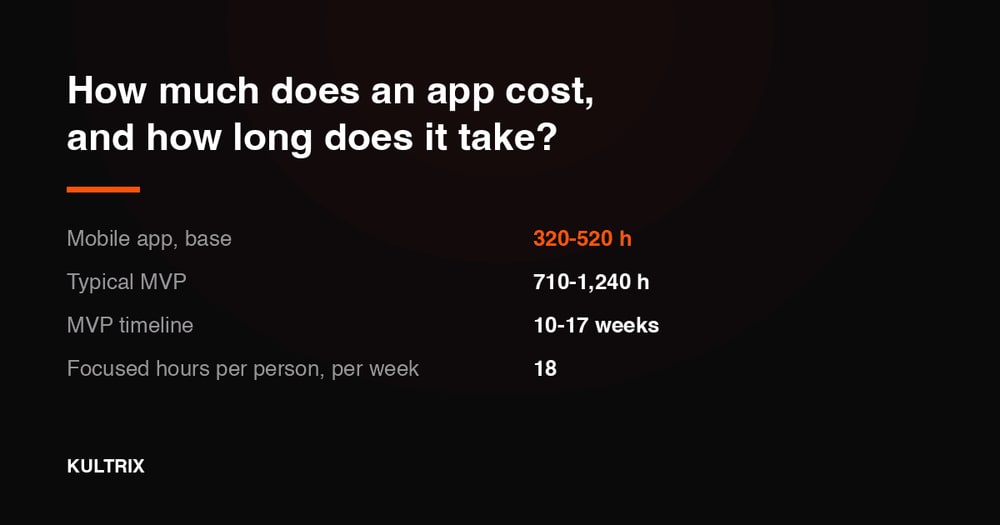
Timeline Typically 9-16 weeks

Businesses

Full App Build

Complete cycle from initial strategy and design to final launch.

What's included

  • Custom architecture & design
  • Seamless team integration
  • Production-ready release

Timeline Typically 20-40 weeks

Enterprises

Team Extension

Scale your team with expert developers to accelerate development.

What's included

  • Senior-level developers
  • Seamless team integration
  • Flexible management

Timeline Flexible / Long-term

OUR PROCESS

How We Work

We specialize in creating user-centered & innovative solutions. Delivering seamless digital experiences.

Discovery
ResearchFlow MapUser Interview
Solution
ArchitectureWireframesPrototyping
Development
Sprint CyclesCode ReviewQA Testing
Launch
DeploymentMonitoringHandoff

EXPERT INSIGHTS

Proactive vs Reactive Maintenance

Reactive maintenance fixes problems after users report them. Proactive maintenance prevents incidents before they impact your business.

Go With Proactive Maintenance

  • Dependency patching

    Automated Dependabot PRs and monthly security audits keep vulnerabilities from accumulating.

  • Performance monitoring

    Datadog or New Relic baselines catch degradation before users notice.

  • Uptime SLA protection

    Synthetic monitors alert on-call engineers before customers are affected.

  • Lower total cost

    Preventing one outage typically saves more than months of proactive maintenance retainer.

Go With Reactive Maintenance

  • Lower monthly cost

    Pay only when issues arise - no retainer commitment.

  • Simple to start

    No monitoring setup or alerting infrastructure to configure.

  • Suitable for low-risk apps

    Internal tools with low traffic can tolerate occasional downtime.

  • Ad-hoc flexibility

    Engage developers as needed without ongoing contracts.

EXPERT GUIDANCE

Monitoring Stack: Datadog vs Open Source

Datadog / New Relic (SaaS)

Setup Time

Agent install + API key - first dashboards in 15 minutes.

APM Tracing

Auto-instrumented distributed tracing across services.

Log Management

Logs, metrics, and traces correlated in one interface.

Cost

$15-$30/host/month - significant at scale.

Alerting

Anomaly detection, composite monitors, ML-based forecasting.

Best For

Teams wanting fast ROI, SaaS products, compliance logging.

Prometheus + Grafana (OSS)

Setup Time

Deploy Prometheus, Grafana, Alert Manager - 1-2 days to production.

APM Tracing

OpenTelemetry setup required - more configuration.

Log Management

Requires Loki or ELK stack addition for log management.

Cost

Infrastructure cost only - cheaper at high host count.

Alerting

Threshold-based alerts - powerful but manual configuration.

Best For

Large-scale infrastructure, on-premise, cost-sensitive environments.

Figures above are indicative ranges, not a quote. Anything marked as a vendor list price is that vendor's own published price, not ours. Our own work is billed at $35/hour for design and development, $20/hour for QA and $20/hour for project management, a blended $30.5/hour, the same numbers behind the cost calculator. What a project costs on top of that depends on scope, integrations and compliance.

DELIVERABLES

What You Get

24/7 Monitoring

24/7 Monitoring

Uptime, error rate, latency, and infrastructure health monitored continuously with escalation to on-call engineers.

Incident Response

Incident Response

Acknowledged within the agreed SLA, root cause identified, fix deployed, and a post-mortem delivered for every P1/P2 incident.

Security Patching

Security Patching

Monthly dependency audits with patches applied, tested in staging, and deployed within 72 hours for critical CVEs.

Performance Reviews

Performance Reviews

Quarterly performance review covering Core Web Vitals trends, API latency, database health, and cloud cost efficiency.

Backup Verification

Backup Verification

Monthly restore drills to confirm backups are valid and the recovery procedure works before you actually need it.

Monthly Report

Monthly Report

Written summary of incidents, deployments, performance trends, upcoming risks, and recommended improvements.

INDUSTRIES

Tailored Solutions for Your Specific Industry

We build powerful digital experiences across various sectors, ensuring your product meets unique market demands.

(01)

Fintech

Data-driven commerce solutions that improve journeys, boost sales, and optimize operations.

(02)

Retail

Data-driven commerce solutions that improve journeys, increase sales, and optimize operations.

(03)

Healthcare

Reliable medical platforms that protect patient data, simplify workflows, and support clinical accuracy.

(04)

B2B SaaS

Product-driven platforms that enhance workflows, automate processes, and scale with your business.

CASE STUDIES

Our Recent Work

View All

START YOUR PROJECT

Ready to build with expert Maintenance & Support team?

Expert developers ready to deliver high-quality digital products.

FAQ

Frequently Asked Questions

Our retainers include continuous uptime and performance monitoring, incident response within the agreed SLA, monthly security dependency audits and patching, quarterly performance reviews, backup verification, and a fixed number of development hours for bug fixes and minor improvements. We scope the retainer to your application size and SLA requirements - there is no one-size-fits-all plan.

We offer P1 response (site down or data loss in progress) within 15 minutes, P2 (major feature broken) within 1 hour, and P3 (degraded performance or minor feature broken) within 4 business hours. SLAs are agreed at retainer start and measured monthly. We use PagerDuty for escalation and track mean time to acknowledge and mean time to resolve for every incident.

We run automated dependency audits using npm audit, Dependabot, or Snyk on a weekly basis. Critical CVEs (CVSS score ≥ 9.0) are patched within 24 hours. High severity (7.0-8.9) within 72 hours. Medium and low severity are batched into a monthly patch release. All patches are tested in staging before deploying to production, with rollback available for 24 hours post-deploy.

We monitor at four levels: uptime (synthetic checks from multiple regions every 30 seconds), infrastructure (CPU, memory, disk, network), application (error rate, latency percentiles, request rate), and business (key user actions like sign-ups, purchases, and logins). Alerts fire at multiple thresholds - a warning when metrics are trending bad and a critical alert when SLOs are breached.

When an alert fires, the on-call engineer acknowledges it within the SLA, follows the relevant runbook, and posts status updates every 15 minutes in a shared Slack channel. After resolution we complete a blameless post-mortem covering timeline, root cause, impact, and corrective actions. The post-mortem is delivered within 48 hours and reviewed with your team.

Yes. We start with a 2-week onboarding sprint: reading the codebase, reviewing the infrastructure, documenting what we find (including technical debt and risks), and setting up our monitoring and alerting stack. After onboarding we can respond to incidents and handle ongoing maintenance just as effectively as for applications we built ourselves.

We schedule maintenance windows for changes that require brief downtime - database index rebuilds, major version upgrades, certificate rotations - and notify stakeholders in advance. Where downtime is avoidable, we use zero-downtime techniques (rolling deploys, online index creation). Major framework upgrades (e.g. Next.js major version) are scoped as a project, not a maintenance task, and included in the retainer hours or billed separately.

A blameless post-mortem focuses on system failures rather than individual mistakes. We document what happened, when, and why - without assigning personal blame. The outcome is a list of corrective actions: monitoring gaps to close, runbooks to add, code paths to harden. Blameless culture makes engineers more likely to surface problems early, which results in faster incident response and fewer repeated failures.

Yes. Having a backup is not the same as having a working backup. We run a full restore drill monthly - restoring to a test environment and verifying data integrity and application functionality. We document the restore time so you know your actual RTO, not a theoretical one. Many clients discover their backups are incomplete or their restore process is broken only during this exercise.

Retainer plans range from 10 to 40 development hours per month depending on your application complexity and change rate. Hours cover bug fixes, minor feature improvements, dependency upgrades, and infrastructure changes. Hours do not roll over - unused time reflects a well-running application. If you consistently need more hours, we reassess the retainer scope.

Yes. We offer surge capacity on top of the base retainer for product launches, seasonal traffic peaks, or large feature releases. Surge blocks are pre-booked at least 2 weeks in advance. We also staff up monitoring during launch windows - more frequent check-ins, shorter alert thresholds, and engineers standing by - so we catch issues within minutes rather than the standard SLA window.

Our standard notice period is 30 days. During the notice period we work with you to transfer knowledge, documentation, and monitoring configuration to your team or a new provider. We do not hold infrastructure or access hostage - a smooth handover is part of how we work, regardless of why you are transitioning.