OUR SERVICES

API Development - REST & GraphQL

We architect APIs that become the backbone of your product, clean contracts, predictable versioning, and performance built in from day one.

Next step: get your project scoped

Tell us what you are building - what exists today, what it has to do and when it has to be live. We come back with the questions we need answered and a scoped estimate instead of a range.

Describe your project

EXPERTISE

Our Tech Stack

Node.js
GraphQL
REST
PostgreSQL
Redis
AWS

OUR APPROACH

Flexible Engagement Models

Choose the cooperation format that best fits your business goals and development velocity.

Startups

MVP Development

Fast launch to test your idea and gather user feedback with minimal investment.

What's included

  • Core feature development
  • Basic UI/UX design
  • Stable performance

Timeline Typically 9-16 weeks

Businesses

Full App Build

Complete cycle from initial strategy and design to final launch.

What's included

  • Custom architecture & design
  • Seamless team integration
  • Production-ready release

Timeline Typically 20-40 weeks

Enterprises

Team Extension

Scale your team with expert developers to accelerate development.

What's included

  • Senior-level developers
  • Seamless team integration
  • Flexible management

Timeline Flexible / Long-term

OUR PROCESS

How We Work

We specialize in creating user-centered & innovative solutions. Delivering seamless digital experiences.

Discovery
ResearchFlow MapUser Interview
Solution
ArchitectureWireframesPrototyping
Development
Sprint CyclesCode ReviewQA Testing
Launch
DeploymentMonitoringHandoff

EXPERT INSIGHTS

REST vs GraphQL

REST is simple and cacheable. GraphQL eliminates over-fetching and is purpose-built for complex, client-driven data needs.

Go With GraphQL

  • Precise data fetching

    Clients request exactly the fields they need - eliminates over-fetching and under-fetching.

  • Single endpoint

    One /graphql endpoint replaces dozens of REST routes - simpler API surface.

  • Strongly typed schema

    SDL schema is a contract between frontend and backend, enabling code generation.

  • Real-time subscriptions

    Built-in subscription type for live data over WebSocket connections.

Go With REST

  • HTTP caching

    GET requests are cacheable at CDN and browser level without extra work.

  • Universal tooling

    Every language, framework, and testing tool speaks REST natively.

  • Simpler mental model

    Resources, verbs, and status codes - easy to onboard new developers.

  • No client library required

    A plain curl command can call any REST endpoint.

EXPERT GUIDANCE

OpenAPI vs GraphQL SDL

OpenAPI (REST)

Code Generation

openapi-generator produces clients in 40+ languages.

Documentation

Swagger UI / Redoc auto-generate interactive API docs.

Versioning

/v1, /v2 URL versioning - clear contract boundaries.

Caching

HTTP response caching with ETags and Cache-Control.

Error Handling

HTTP status codes (400, 404, 422, 500) - standardized.

Best For

Public APIs, mobile backends, microservice communication.

GraphQL SDL

Code Generation

graphql-codegen generates typed hooks for React, Vue, Angular.

Documentation

GraphiQL / Apollo Studio provide schema explorer and query playground.

Versioning

Schema evolution via deprecations - no versioned URLs needed.

Caching

Requires APQ (automatic persisted queries) or a CDN-aware setup.

Error Handling

Always returns 200 - errors in response body need custom parsing.

Best For

BFF (Backend for Frontend), complex dashboards, multi-client products.

DELIVERABLES

What You Get

API Architecture

API Architecture

Designed endpoint structure, resource naming, versioning strategy, and data contracts before a single line of code is written.

Auth & Permissions

Auth & Permissions

JWT or OAuth 2.0 authentication with role-based access control covering every sensitive endpoint.

Rate Limiting & Cache

Rate Limiting & Cache

Redis-backed rate limiting and response caching that keeps latency low under heavy traffic.

OpenAPI Docs

OpenAPI Docs

Auto-generated OpenAPI 3.0 documentation so your team and partners can integrate without hand-holding.

Test Suite

Test Suite

Integration and contract tests covering happy paths, edge cases, and failure modes with CI enforcement.

Deploy & Monitoring

Deploy & Monitoring

Containerised deployment with structured logging, alerting, and a health-check dashboard from day one.

INDUSTRIES

Tailored Solutions for Your Specific Industry

We build powerful digital experiences across various sectors, ensuring your product meets unique market demands.

(01)

Fintech

Data-driven commerce solutions that improve journeys, boost sales, and optimize operations.

(02)

Retail

Data-driven commerce solutions that improve journeys, increase sales, and optimize operations.

(03)

Healthcare

Reliable medical platforms that protect patient data, simplify workflows, and support clinical accuracy.

(04)

B2B SaaS

Product-driven platforms that enhance workflows, automate processes, and scale with your business.

CASE STUDIES

Our Recent Work

View All

START YOUR PROJECT

Ready to build with expert API Development team?

Expert developers ready to deliver high-quality digital products.

FAQ

Frequently Asked Questions

REST is the right default for most products: it is cache-friendly, well-understood, and straightforward for third-party consumers. GraphQL shines when multiple clients (web, mobile, partner) need to fetch different shapes of the same data without separate endpoints. We help you choose based on your query patterns and team capabilities, and we can run both side by side when needed.

We use URL-based versioning (/api/v1, /api/v2) for public APIs because it is explicit and easy to route. For internal services we often use header-based versioning or a gateway pattern. We always define a deprecation policy upfront - typically a 6-month overlap - so existing integrations are never broken unexpectedly.

Every API we build goes through OWASP Top 10 review. We enforce HTTPS everywhere, implement strict CORS policies, use parameterised queries to prevent SQL injection, and apply rate limiting to mitigate brute-force and DDoS. Secrets are managed through environment variables or a secrets manager - never hardcoded.

Yes. We regularly build integrations with payment gateways (Stripe, PayPal), communication tools (Twilio, SendGrid), CRMs (HubSpot, Salesforce), and cloud storage (S3, GCS). We wrap third-party calls in retry logic, circuit breakers, and fallback handlers so a partner outage does not cascade into your product.

We profile every endpoint against realistic load before launch using tools like k6. Performance patterns we apply include database query optimisation with EXPLAIN ANALYSE, Redis caching for expensive reads, connection pooling, and pagination enforced by design. We set latency budgets (e.g. p99 < 200ms) and alert when they are breached.

Yes. We auto-generate OpenAPI 3.0 specs from our route definitions so documentation is always in sync with the implementation. We also write a developer guide covering authentication flows, common use cases, and error handling. For public APIs we can host an interactive Swagger UI or Redoc page.

We write unit tests for business logic, integration tests that run against a real database, and contract tests that catch breaking schema changes before they reach production. All tests run in CI on every pull request. We aim for meaningful coverage of business-critical paths rather than chasing an arbitrary percentage.

Absolutely. We perform API audits covering security, performance, design consistency, and documentation quality. The output is a prioritised report with specific recommendations. We then work through improvements incrementally so existing consumers are not disrupted.

For webhooks we implement signed payloads (HMAC-SHA256), retry queues with exponential backoff, and idempotency keys so duplicate deliveries are safe. For heavier event-driven architectures we use message queues - SQS, RabbitMQ, or Kafka - depending on throughput and ordering requirements.

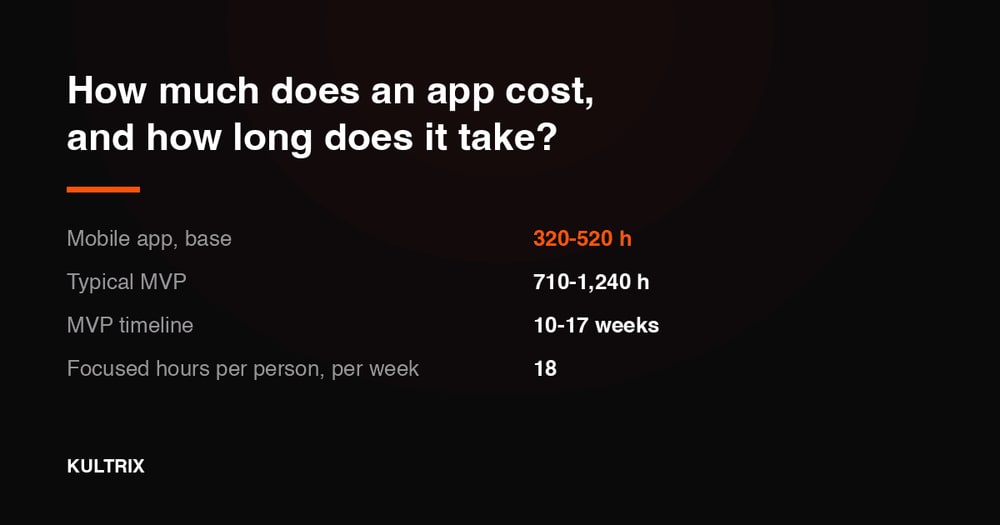
It depends on the number of resource types and how much business logic sits behind them. For sizing, the model behind our calculator counts a web backend as 280-460 hours of base work - schema, endpoints, auth wiring, CI and releases - and every integration with a system you already run as a further 70-180 hours. A well-scoped API of that shape runs 8-15 weeks. Larger platforms with many resource types take longer, and we scope them after reviewing your data model. Price it at kultrix.com/cost-calculator.

We recommend starting with a well-structured monolith unless you have a clear organisational or scaling reason to split early. Premature microservices add operational overhead that slows most teams down. When you do need to split, we plan service boundaries around business domains and introduce an API gateway to manage routing and cross-cutting concerns.

Yes. All code written for your project is yours from the moment it is delivered. We transfer full IP rights, provide access to all repositories, and ensure there are no proprietary dependencies that could lock you in. You can hire another team to continue the work at any point.