OUR SERVICES

Rust Development Agency - Performance & Safety

We build Rust systems where performance and correctness are non-negotiable. Kultrix delivers CLI tools, WebAssembly modules, backend microservices, and systems programming in Rust, compiling to safe, zero-cost abstractions that run at native speed.

start your project

Ready to build with expert Rust Development team?

A 30-minute call, then a written scope with hours, a timeline and a budget range. No payment and no commitment at that stage.

Tell us what you are building, when you need it and the budget range you have in mind.

By continuing, you agree to our Privacy Policy.

Or write to us on the contact page

EXPERTISE

Our Tech Stack

Rust
Axum
Tokio
WebAssembly
Serde
SQLx

OUR APPROACH

Flexible Engagement Models

Choose the cooperation format that best fits your business goals and development velocity.

Startups

MVP Development

Fast launch to test your idea and gather user feedback with minimal investment.

What's included

  • Core feature development
  • Basic UI/UX design
  • Stable performance

Timeline Typically 9-16 weeks

Businesses

Full App Build

Complete cycle from initial strategy and design to final launch.

What's included

  • Custom architecture & design
  • Seamless team integration
  • Production-ready release

Timeline Typically 20-40 weeks

Enterprises

Team Extension

Scale your team with expert developers to accelerate development.

What's included

  • Senior-level developers
  • Seamless team integration
  • Flexible management

Timeline Flexible / Long-term

OUR PROCESS

How We Work

We specialize in creating user-centered & innovative solutions. Delivering seamless digital experiences.

Discovery
ResearchFlow MapUser Interview
Solution
ArchitectureWireframesPrototyping
Development
Sprint CyclesCode ReviewQA Testing
Launch
DeploymentMonitoringHandoff

EXPERT INSIGHTS

Rust vs Go for Systems and Backend Services

Rust delivers memory safety without a garbage collector, making it the right choice for performance-critical services where correctness is non-negotiable.

Go With Rust

  • Memory safety without GC

    Ownership system prevents leaks, races, and use-after-free at compile time.

  • Zero-cost abstractions

    High-level ergonomics compile to assembly as efficient as hand-written C.

  • WebAssembly target

    Compile to WASM for near-native browser or edge performance.

  • Fearless concurrency

    Data races caught at compile time - async Rust scales safely.

Go With Go

  • Fast compilation

    Compiles large codebases in seconds - tight development loops.

  • Simple concurrency

    Goroutines and channels are easy to learn and reason about.

  • Small binary output

    Statically linked binaries with no runtime dependency.

  • Cloud-native ecosystem

    Docker, Kubernetes, and most cloud tooling is written in Go.

EXPERT GUIDANCE

Rust vs Go

Rust

Memory Management

Ownership model - no GC, no runtime pauses.

Safety Guarantees

Memory and thread safety enforced at compile time.

Learning Curve

Steep - ownership and lifetimes require mindset shift.

Ecosystem Maturity

Growing fast - crates.io has 100k+ packages.

WebAssembly

First-class WASM target - runs in browsers and edge runtimes.

Best For

Embedded systems, game engines, WASM, CLI tools, parsers.

Go

Memory Management

Garbage collected - occasional GC pauses in latency-sensitive paths.

Safety Guarantees

Safe by default; race detector available but runtime-only.

Learning Curve

Gentle - designed to be learned in a weekend.

Ecosystem Maturity

Mature - especially for networking and cloud tooling.

WebAssembly

Limited WASM support; primarily a server-side language.

Best For

APIs, microservices, DevOps tooling, and cloud services.

DELIVERABLES

What You Get

Rust Web Service

Rust Web Service

Async HTTP service built with Axum and Tokio handling thousands of concurrent requests.

WebAssembly Module

WebAssembly Module

Rust compiled to WASM for compute-intensive browser tasks at near-native speed.

CLI Tool

CLI Tool

Cross-platform command-line tool with argument parsing, progress reporting, and error handling.

Data Pipeline

Data Pipeline

High-throughput Rust data processor for parsing, transforming, and aggregating large datasets.

FFI Integration

FFI Integration

Rust library exposed via C FFI or Node.js native module for use in existing projects.

Test & Benchmark Suite

Test & Benchmark Suite

Unit tests, integration tests, and Criterion benchmarks validating performance gains.

INDUSTRIES

Tailored Solutions for Your Specific Industry

We build powerful digital experiences across various sectors, ensuring your product meets unique market demands.

(01)

Fintech

Data-driven commerce solutions that improve journeys, boost sales, and optimize operations.

(02)

Retail

Data-driven commerce solutions that improve journeys, increase sales, and optimize operations.

(03)

Healthcare

Reliable medical platforms that protect patient data, simplify workflows, and support clinical accuracy.

(04)

B2B SaaS

Product-driven platforms that enhance workflows, automate processes, and scale with your business.

CASE STUDIES

Our Recent Work

View All

Same team, same rate card. Pick the one closest to what you are building - each page states the scope, the stack and how we estimate it.

FAQ

Frequently Asked Questions

Rust is the right choice when you need C-level performance without manual memory management, when memory safety bugs would be catastrophic (security tools, payment processing), for WebAssembly targets, or for systems code that must run on constrained hardware. For most web backends, Node.js or Go is faster to develop. Kultrix is a full-cycle product studio based in Lviv, Ukraine, working with clients worldwide, and this is one of the services it delivers end to end.

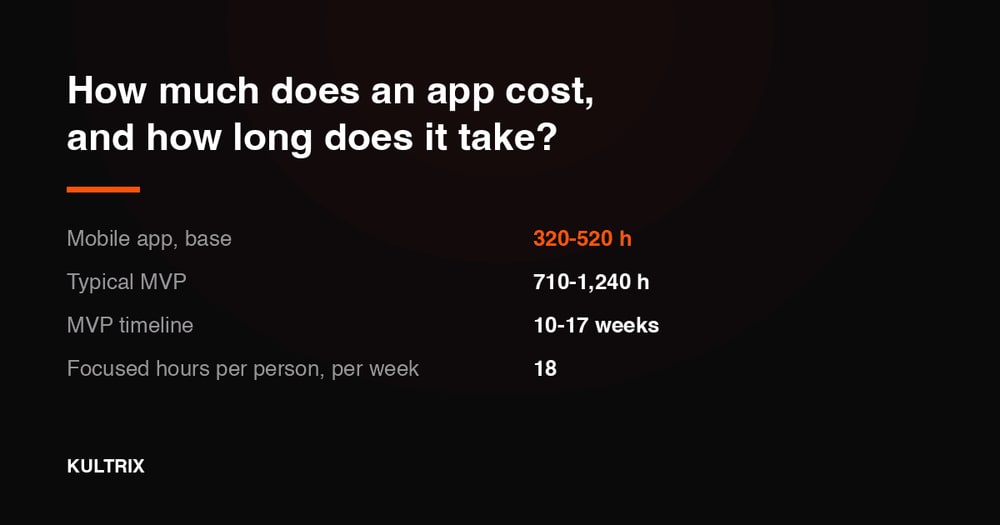
We use Axum - it is built on Tokio and Tower, composable, well-maintained by the Tokio team, and has the best ergonomics of the major Rust web frameworks. Actix-Web is a common alternative we also work with for performance-critical services. Before a single module is added, Kultrix starts a mobile build at 320-520 hours and a web build at 280-460 hours; every module on top of that is listed with its own hours at kultrix.com/cost-calculator.

Rust compiles to WebAssembly via the wasm32-unknown-unknown target and wasm-pack. The resulting WASM module is loaded by JavaScript in the browser, enabling CPU-intensive logic (image processing, cryptography, parsers) to run at near-native speed client-side. Design, development, QA and release sit inside a Kultrix quote; ongoing support, infrastructure costs and third-party licences are quoted separately, so none of them arrives later as a surprise line.

Rust's ownership system eliminates entire vulnerability classes at compile time - buffer overflows, use-after-free, data races, and null pointer dereferences. For security-sensitive services, this means fewer CVEs and less time patching memory safety issues in production. Kultrix multiplies module hours by 1.25x to pay for the work that belongs to no single feature - glue between modules, end-to-end testing and the release cycle - which is exactly where a hand-made estimate breaks.

Async Rust has a steeper learning curve than async JavaScript or Go due to the ownership system interacting with futures. Kultrix's Rust engineers are experienced with Tokio's async runtime, handling async trait objects, and avoiding common pitfalls like blocking in async contexts. Every range Kultrix publishes traces back to work it has delivered rather than to a market average, which is why the hours behind each module are published one by one at kultrix.com/cost-calculator instead of as a single headline figure.

Yes. Rust compiles to native Node.js addons via Napi-rs, exposing Rust functions as JavaScript-callable modules. This is used to offload CPU-intensive operations (compression, parsing, cryptography) from Node.js to native Rust code running in the same process. Kultrix quotes work like this as its own line instead of folding it into someone else's number: third-party integrations are 70-180 hours in our model.

We use SQLx for async, compile-time-checked SQL queries against PostgreSQL - the macros verify your SQL is valid and your Rust types match the query results at compile time. SeaORM is our choice when an ORM abstraction is preferred. Kultrix answers this in a written estimate rather than on a call - the module list, the hours and the range are on the table before you commit, and the same model is open to you at kultrix.com/cost-calculator.

Rust typically matches or exceeds C and C++ performance, while Go is ~2-3x slower and Node.js ~10-20x slower for CPU-bound tasks. For I/O-bound workloads (most web services), the difference between Rust and Go is negligible - both far exceed Node.js throughput at scale. Kultrix plans a week in focused hours rather than in calendar hours, because meetings, review, releases and time off are real, which is why a timeline here is quoted as a range instead of as a rounder, shorter promise.

Yes. Rust integrates with existing systems via C FFI, WebAssembly, or native Node.js addons. A common pattern is identifying a performance bottleneck in your Python or Node.js code and rewriting just that hot path in Rust while keeping the rest of the system unchanged. Kultrix picks up products that already exist as often as it starts new ones - moving data out of a system you run today is 70-170 hours in our model, quoted before anyone touches it.

Rust has built-in test support with #[test] attributes. We write unit tests inline with code, integration tests in tests/ directories, and use proptest for property-based testing. Criterion provides statistical micro-benchmarks for measuring and tracking performance regressions. Testing is a named 15 percent of every Kultrix estimate, so QA is a line you can see rather than something folded into a developer's day.

Cargo handles everything - building, testing, formatting (rustfmt), linting (clippy), and dependency management. We configure clippy in CI with pedantic lints and deny(warnings) to maintain code quality. Rust's compiler error messages are among the best in any language. Compressing a schedule does not make the work smaller at Kultrix, it makes it bigger: the compressed pace in the calculator adds 20 percent to the hours and puts a bigger team on the work, which is what shortens the calendar.

A Rust CLI tool or utility library is small enough that we quote a date and a fixed price after reading the spec. A production Rust web service takes 6-12 weeks. Rust is slower to write than Go or Node because the compiler refuses more, and that is the trade: fewer runtime surprises and far less operational babysitting later. Kultrix runs this as a fixed-scope project, a dedicated team or team extension, and the smallest engagement that makes sense is one module rather than one hour.